It's that time again! National Novel's Writer Month, or NaNoWriMo, is here. It starts midnight tonight. I know that several members of this blog are going to be taking part this year and I thought we could do a mid month check up to see how everyone is doing and how far along they are to their 50 thousand word goals. To kick it off, I'm going to stay up and start writing in the wee first hours of November and see if I can get a good five hundred in before I crash for the night. My goal is to work on new material for my Death Man novel as well as get a start on a new novel that can work as my workshop pieces for the upcoming winter residency where I will be starting my third semester with Pine Manor College's Solstice MFA in Creative Writing.
A word of advise from me for all those out there attempting this wonderful and exciting task: make time. Steal minutes wherever you can. Even if you just have fifteen minutes between things and you think you have enough quiet or concentration to pump out a few paragraphs, then do it. Every little word counts. A book is nothing but chapters and chapters are made of pages and pages are made of paragraphs and those paragraphs are made of sentences and that's where words come in. They are the foundation of everything in literature. Keep the words coming and don't stop to edit (or at least don't stop for too long). Best of luck to my fellow NaNoWriMo participants. Ready, set, write!
Showing posts with label inspiration. Show all posts
Thursday, October 31, 2013
Wednesday, July 24, 2013
Reading is the Thing
I have read three books this month and will read one or two more before the calendar ticks over into August. Reading is part of my homework for the MFA program and as a result it has helped me build up my repertoire of devoured fiction. Each and every day I am reminded via absolutely priceless lines of verse and tear-jerking emotional dialogue and action that reading truly is the most essential building block of a writer and also the most useful tool in a writer's work box.
What are some books that you (contributors and readers alike) have read recently? Take some time to think about what parts of the book inspire, appall, upset, or confuse you. Think about why and also think about how the author has accomplished these this - or not accomplished it as well as you would like. Reading and thinking about what you've read are the two cornerstones in writing.
Here are some books I recommend if you are in need of good reading material. Please, please, please feel free to add to this list. I would like to make a large posting with a composite 'must read' list as recommended by the contributor's of Detangled Writers!
- Grendel by John Gardner
- Battle Royale by Koushun Takami
- Drowned Cities by Paolo Bacigalupi
- The Road by Cormac McCarthy
- Ender's Game by Orson Scott Card
Wednesday, June 5, 2013
Retreat! Retreat!
I want to spend a moment talking about the importance of a retreat where the only expectations put on you are the ones you've put upon yourself. Your goals are all that matter and it is up to you to complete something, polish something, begin something new, or write a million drabbles that make you feel like a complete human being. A writer's retreat is a place where you don't have to worry about dishes or about vacuuming or about who's coming over to dinner tonight or how your hair looks. It's a place where you focus on your writing and on the things that awaken creativity. An ideal retreat, in my opinion, would begin with everyone coming together for some sort of physical exercise (a swim in a nearby lake, playing the human knot game until you finally untangle, red-light/green-light, or even just a nice long hike in the outdoors). Then we would move into something soothing like meditation (guided or personal) and go through a series of long stretches. No matter the person's artistic preference, it is through our hands, our minds, our senses, our bodies that we receive and interpret and create and it is good to keep these things fine tuned.
We would break off then to get to work. It would be for the individual after all. We would make our own schedules and keep them accordingly. I would have meal times listed - that or we would rough it and each fend for ourselves - and we could come together for fellowship and re-invigoration. It would not be a test, competition, or race. Everyone should come with their own goals and work toward them and revise them as they see fit. There may be a communal activity once or twice a day (most likely something physical again and then something more mental). At the end of how ever many days (hours) that we hold the retreat, I think there should be an opportunity to showcase a piece of what we worked so hard on. We could have a reading or we could pass out a packet to look over. This retreat would not have to be limited to writing, though I would suggest special emphasis in this area.
We've had a few ideas thrown around on this site for workshopping and other communal efforts to encourage ourselves and each other to continue working on our goals. I propose a small writer's retreat as a way to generate lots of new material without the distractions of the everyday world. There could even be a workshopping segment of the retreat to help authors who want to polish up their material. What are some thoughts on this? Of course cost is something to keep in mind, but if this were to be something we could do in the summer months, it would be feasible to do a sort of camp out. There are places that have rec rooms with electricity for us to use. Or we could even do a two day retreat and rent out public park spaces such as the one at Kiwanis park where electricity is available. You don't need a large group to have a retreat - it is more than practical to have a retreat of just one. If you can't meet up with fellow writers, you can always pick up some goodies and lock yourself away in a hotel somewhere for the night.
The most important thing of all in these retreats however, is that you have privacy and can remain relatively untouched by the troubles of the real world. This is definitely something I want to look into having. For further information on some already established retreats visit here and here! Or check out this guidebook: here. These are just a few things about retreats, the internet is full of them and with such boundless reference material at our fingertips, it seems a darn shame not to take advantage of having a retreat all our own. Or at least all on one's one.
Amanda LaFantasie (Skoora)
Sunday, May 19, 2013
A Writer's Journey - Art as an Inspiration
(c) Elizabeth Kelly (ToryKasper) & Amanda Lafantasie (Skoora)
Oh, it feels good to be back. I apologize for my recent absence. I was cleared by the admins to take a break away from DW in order to focus on my studies at Uni. Well now that the semester is over I make a triumphant return, and for my first post of the summer I want to talk a little bit about inspiration. This is something we as writers are all familiar with, and there are a million and one phrases (probably more) about where inspiration comes from, how we are our own inspiration, and how we use our inspiration.
Many writers (including myself) find inspiration from music. There are many other forms of inspiration though, and I thought it might be prudent to talk a little about my own writing process, and how I work through the pages. It's quite a simple issue, while being altogether complex. Let me explain this in one word. Illustration. In many ways I differ from most artists, who have an image in their head that they get down onto the page through words. My inspiration comes first from my artwork.
(c) To Elizabeth Kelly - ToryKasper
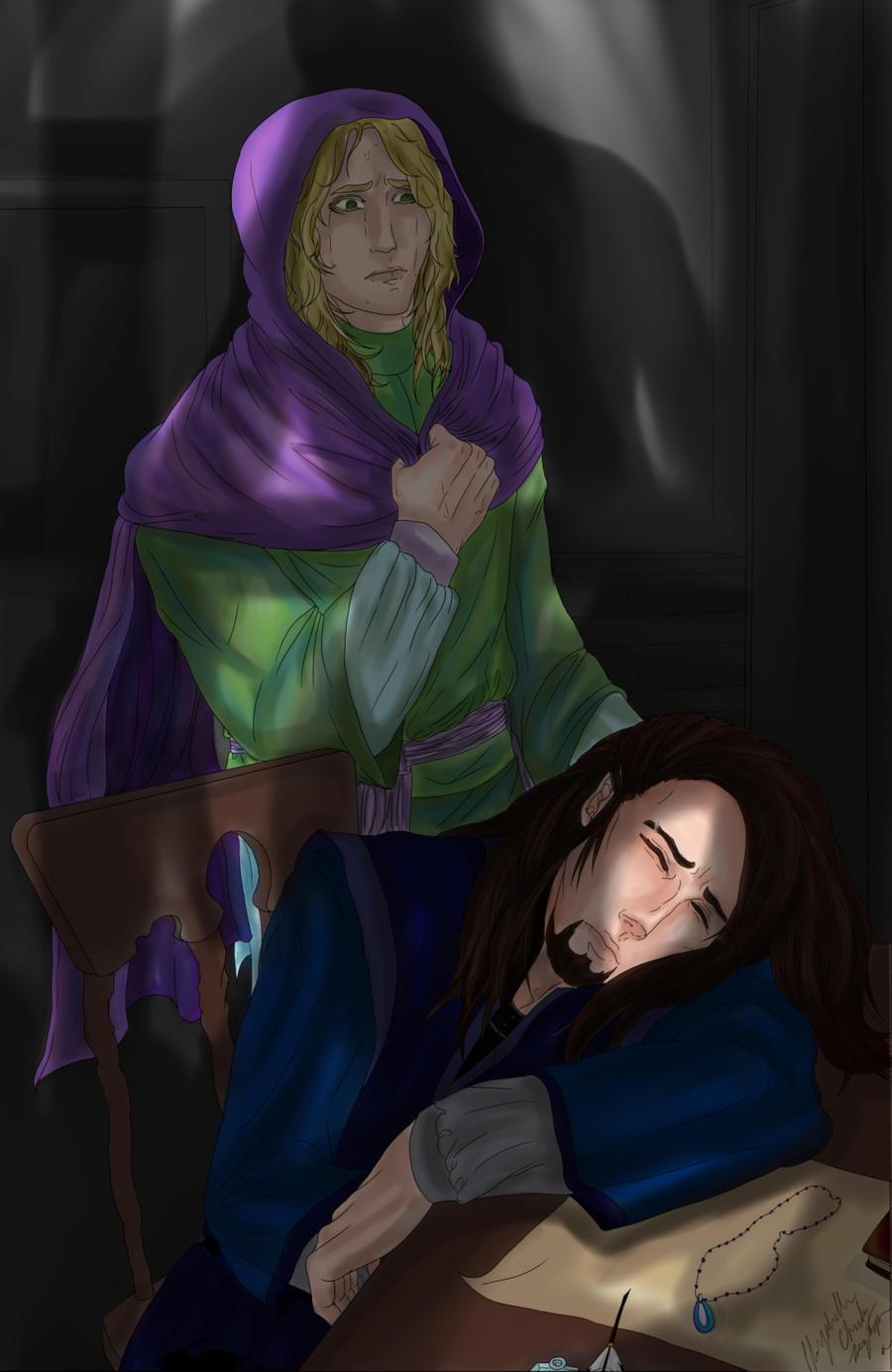
For example. This is a picture that I drew, that started one of the most in depth stories I've ever written, coauthored by Skoora (Amanda Lafantasie). this is only one example of how a picture has influenced one of my stories. I often will struggle with what to write, my imagination not as vividly connected to imagery as many of my fellow writers. So I put my thoughts down onto the paper in another way, and from a picture, even a simple one like this one, a story blooms. Sometimes the pictures are simple, sometimes they are more complex, but their purpose is always the same. In terms of a chemical reaction, an enzyme is used to speed up the process, to create a stronger reaction between chemicals, and this is what my artwork does for my stories.
Typically, I have an idea, but then I struggle with how to represent that idea. How do I describe this character? How do I show this scene in words? In what way can I bring setting to life. When I cannot answer these questions easily, I'll turn to my sketchpad or my art program and I'll start to sketch. The characters with my greatest characterization are those I've drawn in scene. The picture above is my namesake character, Tory. He was first built off of a picture too horrible to share, but fundamental in his original concept. From that one picture over a thousand of pages of writing has been born; both collaboratively and on my own. Through out the years since his conception (seven to be exact), he has evolved, changed, moved, and regressed a number of times. He has revealed to me a different part of him, and always through artwork.
(c) Elizabeth Kelly - ToryKasper
This isn't meant to be the most insightful of posts, but a look into my process, and how my characters grow. Sometimes I'm lucky enough to be able to visualize a character in my mind who doesn't need any outward attention to be easy to convey. Another of my collaborative works with Skoora is one of the few exceptions with my character Hal, who quite literally created himself and did and does whatever he wants. For a writer, this kind of character who can act on his own, remain consistent, but also grow, that is ideal. The sad truth is that this is often not true of many characters, and typically they need a nice nudge. Many writers do this through creating playlists, some watch movies, many (well most) read, and some of us draw.
So this brings me to my usual question. How do you find your inspiration, what ways really help you see your characters and inspire you to write? Do you have any suggestions to share?
Labels:
art,
character development,
characterization,
characters,
creative writing,
drawing,
inspiration
Saturday, April 27, 2013
Guided Prompts
So I have a fun idea to get away from the blank page syndrome (a.k.a. writer's block, a.k.a. I-dunno-how-to-start-this-really-cool-idea). Looking back at my writing history I realize that I write better (or at least more profusely) when working off a prompt. This is why Role Play story writing is so successful. Each time you interchange with a partner, it is essentially them giving you a prompt. For any of you out there that might not know what Role Play (RP) writing is, it is just as the name suggests. You write (in third person) the experiences and thoughts of a single character performing an act or a series of acts and then you have a writing partner have their character react to what you wrote. It's a fun back and forth that is not only great writing practice but wonderful at helping you build and develop characters. One of the reason's it's so fun and so successful is because you are kept wondering what your partner will write because that is your next prompt.
Back when Yahoo!360 was an active site (may it rest in peace), I used to write a few short segments based on prompts I found on sites like Writer's Digest. One such story was about a person receiving a text from an unknown number. I pumped out a generous amount for such a tiny prompt and had thoughts to even take it further. Now, when I say 'prompt' it doesn't necessarily have to be 'It was a dark and stormy night when Mrs. Winters went outside to look for Pooky and found...' like that. I mean even a self prompt like 'what would I do if I won the lottery.' Things like that to get the juices going. And this brings me to the point of this blog post: guided prompts. If you have an idea and you want to write about it but aren't sure how to get started, try prompting yourself into scenes.
I have an android piece that I am itching to work on and so far I have about five different beginnings, all of which I despise and I know that it's because I'm putting too much pressure on myself to make it 'perfect' and I'm not letting myself just relax and write (which is kind of the point of writing, right?). So what I'm going to do is give myself specific prompts.
Idea: Dystopian Android Tribe
Prompt: Leader of Android Tribe comes across a dead human. What does he do?
Prompt: Androids find a baby and attempt to raise it.
Prompt: Androids think of themselves as 'living,' how do they react when someone tells them they have no value and are just pieces of machinery?
Prompt: Show the androids breaking or following the three laws of Robotics.
Prompt: Do androids really dream of electric sheep?
Prompt: It was a dark and stormy night... wait... no, I meant: one of the androids falls into disrepair, how do the androids react to the 'death' of one of their own?
These are all scenes that could potentially work themselves into the book, but the real purpose of these prompts is to get me somewhere in character and plot development and, ultimately, to get words on the page. I will most likely be answering some of these tomorrow and posting them on my Gurgle Burp blog. I know that the idea as I've written it is very vague (trust me I do have a bit more of a plan in mind than just that), but if you have any prompts for that idea, please post them and I will attempt to answer them as well! Prompts are fun, dang it. They shouldn't just be used to generate ideas, they can also be employed to fuel ideas that are already hatched and eager for development.
Amanda LaFantasie (Skoora) © April 2013
Labels:
books,
brainstorming,
Challenge,
character development,
creative writing tool,
Feedback,
free writing,
Goals,
inspiration,
pantser,
plot,
prompt,
prompts,
Reading,
short story,
Skoora,
writer's block,
Writing
Wednesday, April 3, 2013
Progress Report for Skoora
One thing that we discussed is narrative authority. I tend to write 'somehow' and 'perhaps' when writing in observant third person and not writing directly from the characters experience. This makes it sound as if I, the god-like narrator, does not know how or why something happens. The character does not know these things, but the narrator definitely does. This is something I definitely want to work on because a vast majority of the stories I want to write will depend greatly upon the credibility of the observer narrator.
This month is a Camp NaNoWriMo month and I am signed up with a 20,000 word goal. Usually I try and crank out the 50K but since the majority of what I am writing right now is coming to me slowly and with much revision and polishing, I figured a smaller goal would be less stressful and much more feasible. I'm curious about my fellow contributors: are any of you participating in NaNoWriMo this month and if so what kind of projects are you undertaking? I am working on my dystopian novel as well as a few short stories that may be lead ins to future novel projects.
© Amanda LaFantasie (Skoora) 2013
Sunday, December 30, 2012
Getting Ready for Solstice
This Wednesday I head out for Boston, Massachusetts. I have been accepted into the Solstice MFA Program for Creative Writing at Pine Manor College and will be attending my first of five residencies. These next ten days include a rigorous schedule of craft and seminar classes as well as nightly readings by professors and early morning workshops. There are eight people in my workshop groups and I have read all but one of fourteen pieces. I will finish that up tonight and then, upon my second read through, I am going to mark up and annotate all the places that pique my interest, confuse me, or otherwise deserve some type of comment. It's been very interesting reading what others, outside my specific circle, are writing. A trend I am seeing is the need to put everything in present tense or first person and sometimes both. I don't mind this really and, in fact, I am looking to explore this a bit myself. Some of the pieces I've read so far leave me wanting more while others leave me fairly content (or not very content) and not really looking for anything further from them. The workshops should be very eye opening as I've not had a read workshop since I was in college at Mesa State about seven years ago.
On my Prime Cuts Goal List for this blog, I mention five things I want to work on as a writer: time management, perpetuation of creative juices and inspiration, finishing what I start, Grad school, characters, and my letter of intent as part of my admission into an MFA Program. I am very excited and nervous because once I arrive in Massachusetts and engage in the residency, I will be working on all of these goals simultaneously. Well, all except for the letter of intent which I can put a huge slash through as I not only accomplished it, but used it successfully to get in to Solstice.
I hope to get in a blog post from Massachusetts and share the valuable tidbits that my classes and seminars promise to be peppered with, but in case I don't get a chance to do an update in the next two weeks, you now all know why. My classes for this residency are as follows: Craft Analysis, The Future Now: Dystopia, Magic Realism, Unforgettable Characters, Teaching Composition, Adjusting the Sails, Raw Material, and Changing Lives Through Literature. Massachusetts here I come! Also, as a side note, one of the several novels that I was encouraged/required to read prior to attending the residency is The Drowned Cities by Paolo Bacigalupi. So far I find it to be a fantastic young adult read. It's not for the squeamish, that's for sure, but, just like any good Dystopian novel, it is sure to frustrate and invigorate. I recommend it highly.
Amanda LaFantasie (Skoora) © 2012
Saturday, October 27, 2012
Getting Ready! NaNoWriMo
Five days, counting today, until National Novel Writer's Month. I have been stuffing myself with a variety of books to get into the mood. Most recently I finished How Not to Write a Novel and found it to be an unexpectedly fantastic read that pretty much says it how it is. Also, it talked about vanity publishing and e-publishing as a possible option but not the end goal for serious authors. Another book that I'm still reading is Writing Horror by Edo Van Belkom. I have found this to be very informative in looking at the physiological effects that books have on their readers and how different genres affect different areas of the body. For instance, fantasy affects the heart (the feeling of wonder and awe, hopefulness and bedazzlement). Science fiction affects the mind and forces the reader to think (it's up to the author as to exactly what they should be thinking about). But in Horror, it's the gut. Interestingly, Erotica also attacks the gut which is why erotic horror and sex and violence tend to be so closely linked. I find this concept very fascinating.
For this November, I would like to focus on what part of the body I am trying to affect. However, just as in acting, you can't put the desired outcome before the process. You can't say 'be evil' when portraying Lady Macbeth and call it good. You can't say 'I want this to make my reader hotter than July' and expect it to happen. When trying to 'be evil' you have to feel what she feels, justify her every emotion to yourself, and imagine the most trivial of physical attributes such as nervous sweating and the way your tummy feels when you are angry. And so, when you set out to make your readers guts twist in anticipation, you have to start by analyzing what sorts of things actually cause arousal. During NaNoWriMo I would like to work with the building blocks of horror and eroticism and, hopefully, at the end of the month I will have something that affects the human body in just the right way.
But then again, it is NaNoWriMo, and while I'm aiming at creating a deliciously erotic tale of terror, I will be happy to just 1) accomplish the word goal for the month, 2) work on only one or two projects during the month and actually generate some length, and 3) have a complete or near complete manuscript to work with at the end. I think a good exercise (one that is mentioned in Van Belkom's book) is to take time and generate ten really interesting story ideas. They can be as comprehensive or as vague as you want. My addition to this exercise is to add ten story endings to the mix. They don't have to relate to the beginnings in any way. In fact, you can write a story completely based off the ending idea rather than the beginning one. I think that having an ending in mind can be a real life-saver (or a total downer depending on the writer and their process). During the next five days, I will be making a list of ideas both new and old as well as doing various primer exercises. I intend to grab November by the horns.
Amanda LaFantasie (Skoora) © 2012
Labels:
books,
Challenge,
creative writing tool,
erotica,
Goals,
Horror,
inspiration,
prompts,
Skoora,
Writing
Wednesday, October 10, 2012
Heffron Prompts: Part II
PROMPT: Spend at least three sessions practicing the "stay in the chair" method. Set a timer for your session, and write whatever you want, perhaps responding to a prompt in this book. Do not for any reason get up from the chair. Turn off the phone, shut down your e-mail, tell family members that you are not to be disturbed unless someone is facing a life-or-death situation. If the idea you're exploring stalls before you finish, begin a new one or simply write about writing or describe the room in which you're working. Your goal is to practice staying in the chair.
PROMPT: Create a new element of the story that is being kept secret by one of the characters. Allude to this secret somewhere in the first scene. As you move ahead, slowly reveal the secret, one that adds another complication to the story. You needn't know the secret yourself when you start writing. Allow yourself to discover it as you write.
PROMPT: Steal a line from something you've read. It might only be a phrase, but grab that sucker and plunk it into a piece of your own. If you don't have a piece in progress, spend a session exploring an idea in which that line or phrase can appear.PROMPT: Describe a process. This exercise is a standard in technical writing courses. Students explain the steps involved in doing something, such as fixing a flat tire or installing a water heater. Spend part of a writing session describing a process. Then look for ways of weaving this process into the work in progress. For example, in her essay on how to write the lyric essay, Brenda Miller describes how to make challah bread. She uses the process to enlarge the essay and make her points about craft in a more lyric way. In fiction, describing a process can have the same effect, the most famous being the chapters in Moby Dick that describe the techniques of whaling. Your fictional character, rather than react to his wife's leaving in the typical ways, might carefully wax his car. Don't look for obvious parallels when deciding on which process to describe. Choose one you know well or one you can research.
~*~
Prompt excerpts from: Heffron, Jack. The Writer's Idea Workshop: how to make your good ideas great. Cincinnati, Ohio, 2003
For other more prompts from The Writer's Idea Workshop, please check out Heffron Prompts: Part I.
Amanda LaFantasie (Skoora) © 2012
Sunday, October 7, 2012
A Lesson in Discouragement
In reading Edo Van Belkom's Writing Horror, I have come across a very interesting, though completely logical, idea. The author of the writing guide talks about how he always tries to discourage amateur writers from continuing seriously in the craft. His thought process if that if one man can discourage an ambitious writer to abandon their dreams then those weren't really their dreams, were they? His point in all of this is that, as writers, we will be subjected to massive amounts of criticism, rejection, ridicule, and other forms of discouraging verbal abuse. A real writer deals with this in whatever way works best (maybe they have a few minutes for a pity party), then they push forward and continue on writing, revising, rewriting, editing, submitting, and preparing themselves for a brand new round of rejection.
The lesson in all of this, is to persevere. If you are a writer - a blogger, an essayist, a novelist, a poet, or even an aspiring columnist - then you can't let anyone or any group discourage you from what you really want. Thicken up your skin if you have to, and keep your rejection letters in a folder that can be easily thrown away when it becomes too overwhelming. And also remember that rejection doesn't necessarily mean they don't like it - it just means your story is not what they are looking for right now, so either wait until your story is what they are looking for, or send it somewhere else where it will be better received and get your butt going on a new project. So next time you're in a class, a writing group, an open mic night, or chatting in a forum and someone says that you should throw in the towel, just shrug it off because the only person who can make that decision is you and, if you call yourself a writer, then you've already made your choice.
Amanda LaFantasie (Skoora) © 2012
Labels:
books,
Feedback,
Horror,
inspiration,
insults,
road blocks,
Skoora,
Writing
Saturday, October 6, 2012
Naked in Silk: Playing With Sensations
![]() |
| I have a kimono from Japan that I used to wear around my room with nothing underneath. |
Start by touching things in your house from the walls to the coffee maker. Take your clothes out of your closet and molest them shamelessly. Look at the tags and see what they are made of and take notes. Like the note under the picture says, I have a kimono from Japan, and I, when I was thinner, used to get naked and put it on and then go about my business. I declare that silk is one of the softest, soothing fabrics I have ever had the pleasure of wearing/ touching.
After you've played with your household things seek out the elements starting with the basics. Earth, Air, Fire, and Water.
Fire is one of my favorite elements. It warms you when you are cold, provides light, and can entertain. So light a candle and carefully, you don't want to burn yourself, move your fingers over the flame. Watch the flame flicker. If you have a fire place examine how it dances and note how it makes you feel inside. Is there comfort? Is it too hot?
Air is nice as well. Aside from needing it to breathe it can be comforting or annoying. Although you can't see it you certainly can feel it. One of the things I get great pleasure from is lying in my underwear during the early spring and autumn months, when their is a nice breeze, near an open window. I usually like to read then and relax with the breeze blowing over my skin. It's really nice and certainly recommend trying it. I also love sitting outside and letting the wind lift my hair. It's neat to see how the wind plays with the strands.
Water is amazing! Either sitting in a hot tub, warm bath, or a cool pool, it just feels good. to me at least., some people don't like water. But why? Wouldn't that be an interesting character fact? Playing with water from wading in a river, swimming, taking a bath, or filling the sink and just playing with it, take notes on how it feels.
Earth. There are so many things to touch when it comes to earth. Moss, trees from their leaves to their bark. Stones in the sun to those in the shade. Flowers and grass. Take your shoes off and walk in the grass (provided there aren't any stickers those suck). Play in the leaves. One of the things I loved most about working in the family garden when I was younger was playing in dirt. Sure mud is fun, but the dirt was really fun. In the sun it was warm and if it was dry you could grind it down to powder until it was soft. In the shade it was cool and if it was moist it was an interesting texture.
Things in your house and in nature aside there are man made things outside your home that are fun to touch and take note of. Several years ago, when Earth Final Conflict was airing on cable T.V, there was an episode where the Taelons gave a girl who didn't have hands, hands. Real, honest to goodness hands. She was talking to one of the other characters about what she liked to touch the most and she said bricks. I remember thinking that I'd never really paid much attention to bricks so I went outside and felt the bricks along the front of the house. They were rough and at the time they'd been in the sun so they were warm. After that I touched my Dad's car, the big dumpster down the way, and so on.
So how about an hour or two some afternoon to just touch things? Even if you don't ever put the details in a story, having some fun and just experiencing the different sensations you get from what you feel can be interesting and you might just learn something a little extra about yourself.
Wednesday, October 3, 2012
Heffron Prompts: Part I
I am currently reading The Writer's Idea Workshop; how to make your good ideas great by Jack Heffron. I am four chapters in and while much of what I am reading has been touched upon in other writing books, this one has struck a singular cord within me. In Heffron's book he talks about how we, as writers, often talk an idea to death and then lose all drive to write about it and how we should keep some ideas secret until we have enough written on the page to sort of rope us into the project rather than allow the idea to exist as some ideal that we will never actually work toward finishing. I am ever so guilty of this and that is why my current project - something that I've mentioned in passing to Crimson - is going to remain under wraps until I have a few chapters pumped out and can make a real decision on whether or not this idea is any good. In the mean time, here are some of the prompts from his book, which contains over three hundred prompts, that I found particularly interesting and useful.
PROMPT: If you have an idea that you've been carrying around in your mind for a while, stop reading this book and put something on paper. Even if you can only spend five minutes doing it, spend the five minutes. If you're hesitant to begin writing, just describe the story in a paragraph or write five possible titles or name all the characters. But do it now. This very minute. I'm not kidding. Go. You shouldn't be reading this sentence, unless you've taken time to do this prompt.
PROMPT: Write a pledge to yourself to keep secret an idea for a writing project. Tell no one about it. If you tend to be a blabbermouth, as writers often are, give the pact with yourself a time limit, such as: "I'll keep this idea a secret for one month, during which I'll write a little something on it every day."
PROMPT: If you've been working on a piece for a good while and feel it may be time to let go, put it away for a while, give yourself a deadline for working on it. For example, tell yourself you'll spend the next five sessions on the piece before putting it away. Then, stick to that schedule, even if the piece suddenly comes to life. If it does come to life, you can bring it out again later but for now you've decided to move on to something new.
PROMPT: Write about a place you've never been, one in which you've always had an interest or somewhere that has inspired a feeling of connection. Investigate your interest or connection.
PROMPT: Create a prompt of your own. One of the themes of this chapter is that creativity requires moving past what you've been told to do, and so what I'm telling you to do is tell yourself what to do. You might want to brainstorm a half-dozen "assignments" and choose one to explore in a session. The key here is to set forth your own task and then find ways to accomplish it.
PROMPT: After a writing session, write a congratulatory note from your ideal reader to you. The reader should tell you he or she loves your idea.
Excerpts from: Heffron, Jack. The Writer's Idea Workshop: how to make your good ideas great. Cincinnati, Ohio, 2003
~
I, for one, jumped on that first prompt! I hope that some of you will do the same. Don't get stuck on a project that is taking forever and eating up the time that you could be using practicing, polishing, and, most importantly, creating! I put some of these prompts up with specific contributors in mind but I hope these are useful to any and all of our readers. For more prompts please check out Heffron Prompts: Part II.
Amanda LaFantasie (Skoora) © 2012
Tuesday, October 2, 2012
Dream a little dream for me
I think just about everyone has dreams. Happy dreams, sad dreams, and dreams that make you want to spit nails when you wake up, wake up in a cold sweat-heart-racing-terrified dreams, and dreams that are so outlandishly crazy and chaotic that they just don't make any sense. Sometimes our dreams are influenced by something we've watched on TV, a movie, something we've read or played. Sometimes they are influenced by food, cheese and popcorn seem to really make mine colorful. But whatever it is, in the end, we all end up dreaming (unless you're a person who can't dream).
I have a hard time winding down at night to go to sleep. My head races round and round, passes itself on the racetrack and generally makes me cranky. I've had this problem since High School and the best way to get my head to focus one thing so I can settle down, is to tell myself a story or in some cases, I demand that Skoora tell me one. Occasionally what ever I've told myself or what ever she's told me sneaks into my dreams thus creating something strange, although most of the time it doesn't, or I've slept too hard to remember. What's important here are not the stories, what you ate, or anything else except the dreams themselves because sometimes, just sometimes you can take something from those dreams to add to a story or create an entire story from them.
Now just hear me out, I know dreams are freaking weird. I once had a dream that John Travolta in his Battlefield Earth costume/make up was chasing me along a beach. I hid in some cave and ended up running through them and coming out in a forest. From there I ran along a path to gate which protected fifty or so tree houses that made up a convent of nuns. To top it off Angel from Buffy the Vampire Slayer was out in the day light helping the nuns with something, what I can't remember. What I do remember is that I had to get my butt into the tree house convent else John would get me. I'm not joking, this dream happened, and I've never even seen Battlefield Earth. But I kept a dream journal next to my bed and the only reason I remember this dream is because I wrote down as much as I could remember before I lost it. In this particular instance, I haven't used anything from the dream in a story. However, I've used elements or ideas that come from my dreams in other stories.
My challenge to you, try keeping a dream journal next to your bed. Try to get in the habit of writing down your dreams if you have time and can remember them. See if you can spin a story out of one or all of them, or maybe even add little things from one dream into a story and something from another.
Friday, September 21, 2012
Pocket Muse Excerpt: Ten Commandments
TEN COMMANDMENTS FOR A HAPPY WRITING LIFE
- Don't wait for inspiration; establish a writing habit.
- Take time off.
- Read voraciously.
- Shut out the inner critic.
- Claim a space.
- Claim some time.
- Accept rejection.
- Expect success.
- Live fully.
- Wish others well
Excerpt from Monica Wood's The Pocket Muse: Ideas and Inspirations for Writing
Wood, Monica. The Pocket Muse: Ideas and Inspirations for Writing. Cincinnati, Ohio, 2002
~*~
These are the commandments that Monica Wood prescribes for fellow writers to have a happy and fulfilling writing life and in this list is the summary of a good deal of the lessons contained within her book. I thought it might be interesting for us to compile individual ten commandment lists and then make a master Detrangled Writer's Ten Commandments list as a compilation of our own experience, drives, and writing desires.
Amanda LaFantasie (Skoora) © 2012
Wednesday, September 19, 2012
Pocket Muse Challenges: Egg-timer and Emails
First challenge: Egg-timer
Excerpts from Monica Wood's The Pocket Muse: Ideas and Inspirations for Writing
Wood, Monica. The Pocket Muse: Ideas and Inspirations for Writing. Cincinnati, Ohio, 2002
Amanda LaFantasie (Skoora) © 2012
Set an egg timer for forty-five minutes, and don't get out of the chair until the timer dings. Even if you sit staring at the page the entire time, you're ingraining a habit.
Chickens and fraidy-cats may begin with five-minute segments.
(I love the little taunt that Monica Wood adds to this challenge. I think that creating a habit for writing is vital if you are going to be productive. It is like going to a gym/recreation center: you have to set a schedule and go, no matter what. Even if all you do is walk slowly around a track or just sit in the hot tub for a while, you still need to go. Develop the habit.)
Second challenge: Emails
Don't check your email today until you've written three pages.
(This is a way to create another helpful habit, putting work before play. I don't know that most of us would be able to put in three pages before tending to email, but maybe make a work count goal or a goal of however many pages you are able to before succumbing to curiosity. If email doesn't work as a reward in this challenge, use something else, such as television. Tell yourself you can only watch T.V. after you've written a thousand words. Basically, use the things that distract you to keep you on track.)
Excerpts from Monica Wood's The Pocket Muse: Ideas and Inspirations for Writing
Wood, Monica. The Pocket Muse: Ideas and Inspirations for Writing. Cincinnati, Ohio, 2002
Amanda LaFantasie (Skoora) © 2012
Monday, September 17, 2012
Pocket Muse Excerpt - Maintenance Schedule
I've been perusing The Pocket Muse: Ideas and Inspiration for Writing, and I thought this excerpt would fit in perfectly with our goal oriented blog. The following is Monica Wood's recommended schedule for writers. Some of these goals are things that we would have to work up to, but I feel that this schedule is a good goal/challenge for all of us.
ROUTINE MAINTENANCE SCHEDULE FOR THE WRITING LIFE
- Once a week: Skip to the next part of whatever you're working on, no matter how stuck you feel.
- Once a month: Write all day without talking to anybody.
- Every three months: Send something out for publication, just to keep your hand in.
- Every six months: Clean your workspace: Pitch obsolete files, lumpen draft, rejection slips, leaky pens, old mail. Clear away the dross, and you'll be able to think more clearly.
- Once a year: Take a chunk of time, whatever you can afford - three full days, minimum - and go someplace where your writing will not be disturbed except for eating and sleeping.
Excerpt from Monica Wood's The Pocket Muse: Ideas and Inspirations for Writing
Wood, Monica. The Pocket Muse: Ideas and Inspirations for Writing. Cincinnati, Ohio, 2002
Amanda LaFantasie (Skoora) © 2012
Tuesday, September 11, 2012
A Writer's Best Friend
They say that total immersion is the best way to learn a language and what is writing but the purest expression of any language? If a writer truly wishes to hone their craft, then what better way to learn the craft than by immersing themselves in the black and white of text on paper? Libraries are a writer's best friend. There is something magical about writing in a library. Before the internet, before search engines, before Q&A sites and major online information hubs, there was the library and that is where a writer would go to learn what kind of weapon their character might use, to learn the laws that their bad guy might break, to learn of the clothing worn in Victorian England, and to find inspiration on every shelf. Lately, my cohort and I have been frequenting our local library not only to borrow books, movies, and music, but also to get some writing done. Surrounded by thousands upon thousands of novels, periodicals, picture books, and reference materials I was finally able to clear my head and concentrate enough to write out the entire outline of my grad school admittance essay. It is a few drafts of polishing away from ready.
The best part of writing in a library is that you are never short of information or inspiration whether your aim be nonfiction, fiction, poetry, or research paper. There is joy in wandering the aisles and taking in the sheer magnitude of words and lives behind those words. And if you have an idea of what you're looking for, you can seek inspiration in a more direct way. If your character is a fly fisherman, Mr. Dewey Decimal can help you find detailed books on the subject. If your character reads nothing but Agatha Christie, you might browse the mystery section and put yourself in your character's shoes as you gaze upon the myriad of Marples and Poirots lining the shelves. I browsed the catalog today in hopes of finding inspiration directly relating to the craft of writing and found a variety of books, some of which came home with me. These look incredibly promising for anyone writing mystery, murder or mayhem:
![]() |
| Cause of Death |
![]() |
| Deadly Doses |
These are the ones I ended up borrowing today. So far I am extremely impressed and inspired by 'The Pocket Muse.' I will be sharing some of the ideas contained within this book but I recommend everyone take a gander at it for themselves. Dani has shared a variety of information and prompts from Natalie Goldberg's book, 'Writing Down the Bones,' and I have been so impressed and excited by what I've seen that I couldn't leave it there on the shelf once I found it.
![]() |
| The Pocket Muse |
![]() |
| Writing Down the Bones |
Finally I would like to propose a challenge. I challenge you (contributors and readers) to spend some time this week in a library. Perhaps you have some time set aside specifically for writing. Why not spend that time in place where authors are immortalized, remembered, and born? Even if you don't go there to write, take a stroll through your public library and just see what kind of treasures you stumble upon.
Amanda LaFantasie (Skoora) © 2012
Friday, September 7, 2012
Write Right Now! Inspiration deck
Writing is a great journey, it is a path with the possibility of making us free. And it can do all of this while you sit at a desk.
--From Natalie Goldberg's Wild Mind
Wednesday, August 22, 2012
Generators, Name Lists, and Dolls! Oh, my!
I would like to talk about randomness for a moment. First, nothing is truly random - even when we seek names, numbers, and coin flips from random generators there is some higher artistic power at work that we humans are too puny to comprehend. Yes, I really just said that. Secondly, when a randomly generated name or number or color or whatever is presented to us, it forces us to make a choice and therefore our choice takes away the randomness because suddenly we have ascribed purpose to whatever it is that we have decided. Do I want Chinese food for dinner or American? My friend randomly shouts out, "American!" And because a choice has now been set before me, I can say with full confidence that, no, I actually wanted Chinese food. Canton here I come! It is the same way with random generators on the internet. I put in that I want an Arabic male name and I am presented with one. I now choose whether to accept it (along with all the instant images and ideas that come along with it) or reject it and press the generate button one more time. Even if you limit yourself and say 'I will press the generate button once and whatever comes up is what I shall use' you are still making a choice. You will use that name, research that name, glorify or slander that name, and make a character to be the perfect match or foil to that name.
In this post I have included random generators (as well as already generated name lists) that I have used in the past. What I would like to know, is if you find such things to be enormous wastes of time or if they help you in developing characters in some way. Do they at least help you decide what not to do? Further down the list I have also included generators and visual aides that might help with the design of the character and even the setting in which they might live. I find such things to be very useful in some situations (not all). More often than not, room design and dress up games are just a starting point for me, and then my own imagination and creativity take over. Could such things end up being distractions from the process? Try a few out perhaps and then decide. And of course, it always depends on the situation.
- Name Generator Index (A list of generators that provide you with everything from Hillbilly names to names for your pony.)
- Fantasy Name Lists (A branch of the previous site wherein you can find links to various fantasy name lists, a few fantasy specific name generators, and also the 100 most essential words in anime - talk about random O_o.)
- Names Master List (Another branch of the same site with a plethora of links to name lists for pretty much anything you could think of to name. If it isn't there, it doesn't deserve a name.)
- 20,000 Names (A personal favorite of mine and Crimson Lantern. This is also linked to this very blog. It is a very informative and well categorized name database for practical and fantastical use.)
- Fantasy Name Generator (Just push generate and you'll have a whole slew of interesting and unique names and if you don't like what you see, refresh the results page for more names.)
- Pet Names (as in lovey dovey, not for Fido) (If you have a character who likes to say things like 'sweetie pie' and 'pumpkin tits' this might be a good place to find inspiration.)
- New Identity (This site generates a new name and a whole new identity for you - should you need one O_O - or can be a good starting place for a character. I used it to create a new identity for a character who went into witness protection.)
- Random Name Generator (This site is similar to the last one but with a less intense tone. You can generate based on ethnicity or even race of magical creature.)
- Character Name Generator (D&D) (A place to go if you want some creative names for your Dungeons and Dragons characters, or novel characters who merit such names. Kind of fun.)
- Noemata (I have used this over and over again - it basically pumps out random collections of letters and syllables that are without trademark. It is a good place to look up fake brands for stories or to seek inspiration for cyber-punk or fantasy names.)
- Random.Org (If you are debating on having your character go left or right - this is a place where you can flip a virtual coin or pick a number between X and Y. You can also roll the dice. It's nice if you don't have coins and dice handy and would like to practice randomness in your decision making.)
- D&D Dice Roller (Because I felt like I couldn't leave it off after the last entry. If you need to know how badly your poor character took a beating in that alley last night and you want help deciding - just roll a D20 and let the carnage begin.)
And, as promised here are some other random things that may or may not help you along your way to creativity and production.
- Elizabethan Insults (The name really says it all. Included in this site is a link to an Elizabethan insult generator above and beyond what is already presented. Good fun.)
- Fantasy Dress Up Index (A whole slew of dress up doll games that could give you ideas for clothes, looks, locations,or even anthropomorphic additions to your characters.)
- Doll Divine (The site I use more than others to find dress up doll games for male and female characters. You can screen shot your final creations and tuck them away for further inspiration.)
- Room Sketcher (Design your, or your character's, dream house and give yourself a good visual of where things are located about the house so that you can describe it easily in your writing. I haven't used this site very much at all, but I know others who have found it pretty helpful.)
Randomness is something that writers all come to embrace. Dani posted picture cubes as a writing prompt, others toss word dice to come up with a plot. Some people put names, places, and activities in three separate hats and pull out the makings for a writing exercise or story. There was a musician (a composer) who used to walk around naked then lay on his piano and pound the keys randomly until inspiration struck. It all seems so random and yet it is all a choice. Choose randomness. That is one way to keep the creative juices flowing. In closing, here is a link to Script Frenzy's plot machine: Script Frenzy.Org. Script Frenzy (a sister branch of NanoWriMo) is no longer an event, but the site remains intact for people to make use of their script writing tools which include this plot machine. Randomness in motion. If anyone has any generators or lists that they have found useful in the past, I would love for you to share them with me. And if you have any creative prompts that hinge on randomness, please share those as well.
Amanda LaFantasie (Skoora) © 2012
Labels:
characters,
creative writing tool,
dice,
dolls,
generator,
inspiration,
insults,
List,
names,
prompts,
random,
Skoora
Subscribe to:
Posts (Atom)


.jpg)