Showing posts with label character development. Show all posts

Monday, December 23, 2013

Do you Mary Sue?


I'm taking nine classes for the upcoming residency at Pine Manor College.  One of the classes focuses on speculative fiction, which, if you didn't know, is anything out of the normal realm.  It covers science-fiction, fantasy, horror, dystopian, and much, much more.  For this class, the professor assigned us all to take the Mary Sue Test prior to attending the residency.  It's actually a pretty cool little test.  I took it for my Death Man character and scored a 14.  I recommend everyone to take this test for at least one of their favorite original characters, and I doubly recommend this for those who dabble in the world of fan-fiction.

For people who don't know what Mary Sue means it is essentially inserting oneself into a story and creating a character that is impossibly perfect.  I think there is a masculine form of this term but just as Brony (a seemingly masculine term applied in general to those who enjoy My Little Pony: Friendship is Magic) covers everyone in the gender spectrum, so too does the term Mary Sue.  So take the test and see if your hero/in is too good to be true or too bland to be possible.  Post your scores if you like what you see or post them if you don't like then and give a comment on what you want to change for the character or if you feel that the score is unjustified for the specifics of your character.  Happy writing everyone and Happy Holidays, too!

This Deviant Artist hit the nail on the head in her depiction of a typical Mary Sue story.
Amanda LaFantasie © 2013

Wednesday, October 30, 2013

The Importance of Imagery

This is my craft analysis for my MFA on imagery using Deliverance by James Dickey as the main source. You do not need to have read the book to read this essay and I do not believe there are any real spoilers contained within.  Enjoy!

 
Imagery in the Georgia Wilderness

            Some say the devil is in the details, but when it comes to imagery, I say the ‘difference’ is in the details.   Imagine a picnic scene.  Vivid, sensory descriptions are all that stand between a Monet-esque afternoon, and the third circle of Dante’s hell.  On one hand we have gently swaying ash trees, rolling grasses, polished silver with scalloped edges, and starched, white doilies; on the other we have a threadbare blanket, an overcast sky, enormous deep-fried turkey legs, an ant army descending upon a glob of jelly, and greasy fingers digging into the basket for more.  Could very well be the same picnic, but the images give us vastly different impressions.  These descriptions not only color our perceptions of scenes, they give us a deeper understanding of the novel as a whole, particularly its theme. 
            In the novel, Deliverance, James Dickey reinforces the Darwinian theme – survival of the fittest, or, you have to adapt or you die – through his use of sensory and emotional imagery.  Janet Burroway tells us in her book, Writing Fiction: A Guide to Narrative Craft, “... if you are to realize your characters through detail, then you must be careful to select the details that convey the characteristics essential to our understanding.  You can’t convey a whole person, or a whole action, or everything there is to be conveyed about a single moment of a single day.  You must select the significant” (Burroway 78).  This goes back to the imaginary picnic.  If the theme is ‘rich people are slobs and pigs on the inside’ wouldn’t it be better to use the latter description over the former?  Of course that depends on the context of the rest of the novel.  Looking at Deliverance, which is a story about survival at great physical and emotional costs, it would be strange if the narrator, Ed, who happens to be a novice hunter, only noticed fluffy tails, wiggling noses, and cute features when encountering animals.  Those details have a time and place, but not in this novel.  The imagery in the following passage is what separates Dickey from Disney. 

            “In the middle of this sound the tent shook; the owl had hold of it in the same place.  I knew this before I but the light on – it was still in my hand, exactly as warm as I was – and saw the feet with the heel talons now also coming in.  I pulled one hand out of the sleeping bag and saw it wander frailly up through the thin light until a finger touched the cold reptilian nail of one talon below the leg-scales.  I had no idea of whether the owl felt me; I thought perhaps it would fly, but it didn’t.  Instead, it shifted its weight again, and the claws on the foot I was touching loosened for a second.  I slipped my forefinger between the claw and the tent, and half around the stony toe.  The claw tightened; the strength had something nervous and tentative about it.  It tightened more, very strongly but not painfully.  I pulled back until the hand came away, and this time the owl took off.
            All night the owl kept coming back to hunt from the top of the tent.  I not only saw his feet when he came to us; I imagined what he was doing while he was gone, floating through the trees, seeing everything.  I hunted with him as well as I could, there in my weightlessness.  The woods burned in my head.  Toward morning I could reach up and touch the claw without turning on the light” (Dickey 89).

            Nothing is fluffy or friendly about this owl.  Dickey uses words like ‘reptilian,’ ‘stony,’ ‘claw,’ and ‘scales’ to describe an animal that, in a different setting, might be considered cute.  The image Dickey creates is that of a fit and efficient hunter, everything that Ed wants to be, and, in the end, is forced to become.  In On Becoming a Novelist by John Gardner, the author says that “... the writer who works closely with detail – studying his characters’ most trivial gestures in the imagined scene to discover exactly where the scene must go next – is the writer most likely to persuade and awe us” (Gardner 37).  So much happens in this small scene where Ed touches the owl.  Through his “most trivial gestures” we understand, or have an idea, of what has to happen next.  Already we see Ed adapting himself for survival: “I hunted with him as well as I could,” and, “I could reach up and touch the claw without turning on the light.”
            Sandra Scofield reminds us in her book, The Scene Book; A Primer for the Fiction Writer, to, “... keep in mind that you want details to be part of action, not tacked on for effect.  And do remember to engage all of the reader’s senses, not just sight” (Scofield 112).  The owl passage focuses more on touch than it does sight, but an even better example of “... integrat(ing) description – mak(ing) it a part of the flow of the action of the scene ...” (Scofield 111) occurs during a confrontation between the protagonists and two men who, “... stepped out of the woods, one of them trailing a shotgun by the barrel” (Dickey 107).  The climax moment of this confrontation occurs in sounds:

            “I knelt down.  As my knees hit, I heard a sound, a snap-slap off in the woods, a sound like a rubber band popping or a sickle-blade cutting quick.  The older man was standing with the gun barrel in his hand and no change in the stupid, advantage-taking expression of his face, and a foot and a half of bright red arrow was shoved forward from the middle of his chest.  It was there so suddenly it seemed to have some from within him” (Dickey 116).

            While Burroway tells us, “A detail is ‘definite’ and ‘concrete’ when it appeals to the senses.  It should be seen, heard, smelled, tasted, or touched” (Burroway 75), Dickey often creates images using a combination of abstract and sensual details.  In the following passage there are a number of details that help us see the river on its surface level, “... as if [we] were a movie camera” (Gardner 71), but we also see it as Ed sees it, as something mindless, indifferent, and uncomprehending. 
  
            “What a view, I said again.  The river was blank and mindless with beauty.  It was the most glorious thing I have ever seen.  But it was not seeing, really. For one it was not just seeing.  It was beholding.  I beheld the river in its icy pit of brightness, in its far-below sound and indifference, in it large coil and tiny points and flashes of the moon, in its long sinuous form, in its uncomprehending consequence.  What was there?
            Only that terrific brightness.  Only a couple of rocks as big as islands, around one of which a thread of scarlet seemed to go, as though outlining a face, a kind of god, a layout for an ad, a sketch, an element of design”  (Dickey 171).

            Gardner introduces the concept of the originality of the writer’s eye in On Becoming a Novelist.  Essentially, “Getting down what the writer really cares about – setting down what the writer himself notices, as opposed to what any fool might notice – is all that is meant by the originality of the writer’s eye” (Gardner 71).  The above passage is a great example of that originality.  This isn’t just a river anymore; it’s Dickey’s river.  It’s Ed’s river.  Through his narrator, Dickey captures things about this river that are different from ‘what any fool might notice’ and uses these things to develop his survival theme.  Ed’s life before the river begins to merge with his life now: “outlining a face, a kind of god, a layout for an ad, a sketch...”  He sees the face of a god in recognition of the divine power of nature and he relates it to things he knows from his job, from his life before the canoe trip.  Only this character, presented by this author, could view things this way.  That is the power of imagery and the originality of the writer’s eye. 
            One of the lengthier scenes in Deliverance depicts Ed climbing a mountain cliff.  It is a simple enough action: man climbs mountain.  But the massive amounts of sensory detail that go into the scene’s composition turn it into an intense conflict of man versus nature.  

 “I got on one knee and went cautiously outward, rising slowly with both hands palm-up on the underside of the fissure top.  I was up, slanting backward, and I felt along and around the bulge over my head.  To the right there was nothing I could do, but I was glad to be back.  To the left the crevice went on beyond where I could reach, and the only thing to do was to edge along it, sidestepping inch by inch until only my toes, very tired again, were in the crack” (Dickey 175).

“Time after time I lay there sweating, having no handhold or foothold, the rubber of my toes bending back against the soft rock, my hands open.  Then I would begin to try and inch upward again, moving with the most intimate motions of my body, motions I had never dared use with Martha, or with any other human woman.  Fear and a kind of enormous moon-blazing sexuality lifted me, millimeter by millimeter” (Dickey 176).

            What starts out as ‘man climbs mountain’ turns into ‘man f***s mountain.’  It makes sense in a way.  There is an enormous amount of risk and physical exertion involved in climbing and in love making and Dickey uses this relationship between activities to not only create a visceral image for the reader but to also how Ed’s development in becoming a survivor.  Scofield says, “... ‘description’ isn’t a discreet element in narrative” (Scofield 111), and there is certainly nothing discreet in Ed’s triumph over the mountain:  “It was painful, but I was going.  I was crawling, but it was no longer necessary to make love to the cliff, to f*** it for an extra inch or two in the moonlight, for I had some space between me and it” (Dickey 177).
            The example of the picnic from the beginning gives us a taste of the spectrum of choices an author has to make when writing imagery into a scene, but Dickey’s text shows without a doubt the importance of making the right choices.  In The Scene Book, Scofield says, “Forget those high school classes where you talked plot, setting, character, theme.  Those things aren’t separate!  You want your descriptions to exist as part of action and emotion, part of the meaning of your scenes” (Scofield 111).  Imagery is just one piece of the puzzle.  It’s a piece, if done well, that is entirely unique to each author, and even each character, and it’s the one that makes all the difference. 

Works Cited:

Burroway, Janet, and Susan Weinberg. Writing Fiction: A Guide to Narrative Craft. New York: Longman, 2003. Print.

Dickey, James. Deliverance. Boston: Houghton Mifflin, 1970. Print.

Gardner, John. On Becoming a Novelist. New York: W.W. Norton, 1999. Print.

Scofield, Sandra Jean. The Scene Book: A Primer for the Fiction Writer. New York: Penguin, 2007. Print.


Amanda LaFantasie © October 2013

Wednesday, June 12, 2013

Yummy or ick?


Perhaps you'll never mention anything in your story or writings about food. But what if your character is a food critic or a chef. What if they are a waitress or just going out to lunch or dinner. What if another character has a romantic evening planned with tasty things to set the mood or woo someone? What if someone gets knocked to the ground and gets a mouth full of dirt or sand? Or they get smacked or are in an accident and they get blood in their mouth? What if they are a Vampire or other supernatural creature? What does it all taste like? What can you liken what your character tastes to? 

Obviously I am suggesting that you have a day where you taste things, however I don't want you to go anywhere near anything that jeopardizes your health. And if you are a vegetarian, don't go eat meat. Actually don't do anything that makes you uncomfortable or will make you sick. The idea is to get an idea of what things taste like so if you are allergic to certain things or don't want to try it, just ask someone who likes those things and won't be hurt if they eat or have eaten them.
 

Start simple. You could go to a restaurant and order something new or one of your favorites and take notes about each thing you taste. Or try cooking something at home. Either way simply enjoy the food, feel the textures, concentrate on the spices, and how it makes you feel. 

Expand. Taste things that aren't food, that are safe. Don't go eat a fist full of dirt or sand, and certainly don't do yourself or anyone else any harm. Be safe about it. If you're going to lick a window or a rock, make sure there are no rough edges. BE SAFE! 

Apply what you learn or know to a character in someway. Does your character like TV dinners due to their simplicity because they have a busy life? Do they have any thoughts on if they taste good or if they are simply a means to get by because they don't have the time to go out for food? Are they just too lazy to cook? Do you have a character who only eats organic or maybe they will only eat meals prepared by a chef and don't cook? What if your character can cook and very well, what sorts of things do they like to cook? What if they don't eat food? What would you say a soul tastes like? 

Sunday, May 19, 2013

A Writer's Journey - Art as an Inspiration

(c) Elizabeth Kelly (ToryKasper) & Amanda Lafantasie (Skoora)


Oh, it feels good to be back. I apologize for my recent absence. I was cleared by the admins to take a break away from DW in order to focus on my studies at Uni. Well now that the semester is over I make a triumphant return, and for my first post of the summer I want to talk a little bit about inspiration. This is something we as writers are all familiar with, and there are a million and one phrases (probably more) about where inspiration comes from, how we are our own inspiration, and how we use our inspiration.

Many writers (including myself) find inspiration from music. There are many other forms of inspiration though, and I thought it might be prudent to talk a little about my own writing process, and how I work through the pages. It's quite a simple issue, while being altogether complex. Let me explain this in one word. Illustration. In many ways I differ from most artists, who have an image in their head that they get down onto the page through words. My inspiration comes first from my artwork.


(c) To Elizabeth Kelly - ToryKasper

For example. This is a picture that I drew, that started one of the most in depth stories I've ever written, coauthored by Skoora (Amanda Lafantasie). this is only one example of how a picture has influenced one of my stories. I often will struggle with what to write, my imagination not as vividly connected to imagery as many of my fellow writers. So I put my thoughts down onto the paper in another way, and from a picture, even a simple one like this one, a story blooms. Sometimes the pictures are simple, sometimes they are more complex, but their purpose is always the same. In terms of a chemical reaction, an enzyme is used to speed up the process, to create a stronger reaction between chemicals, and this is what my artwork does for my stories. 

Typically, I have an idea, but then I struggle with how to represent that idea. How do I describe this character? How do I show this scene in words? In what way can I bring setting to life. When I cannot answer these questions easily, I'll turn to my sketchpad or my art program and I'll start to sketch. The characters with my greatest characterization are those I've drawn in scene. The picture above is my namesake character, Tory. He was first built off of a picture too horrible to share, but fundamental in his original concept. From that one picture over a thousand of pages of writing has been born; both collaboratively and on my own.  Through out the years since his conception (seven to be exact), he has evolved, changed, moved, and regressed a number of times. He has revealed to me a different part of him, and always through artwork. 


(c) Elizabeth Kelly - ToryKasper


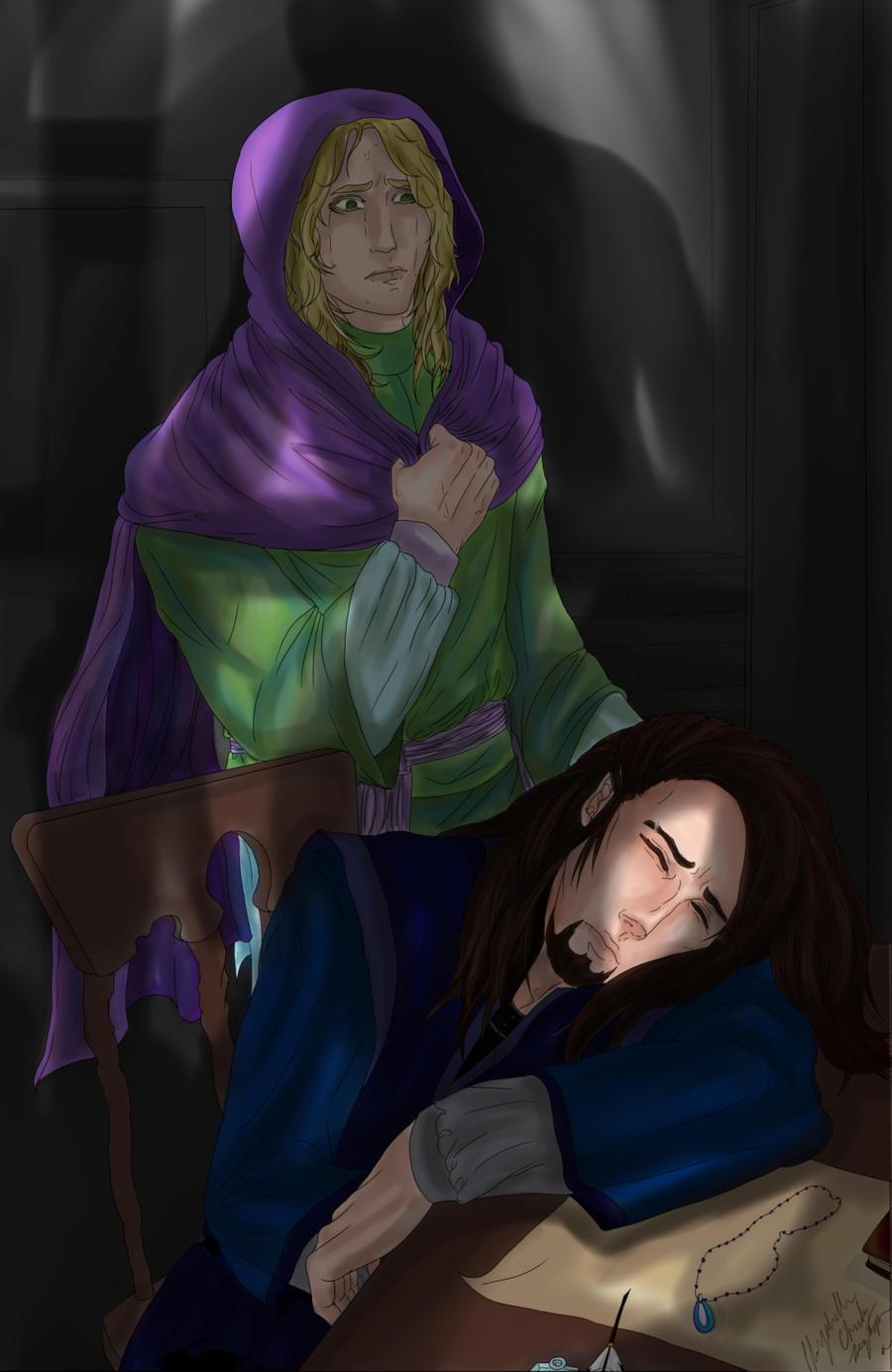
Another example is one of my fantasy characters, Thei, the man in blue sleeping at the desk. This is a character who has hundreds of pages, over a dozen different forms since his creation, and who has grown, and changed and inspired me as a writer a number of times since I conceived him.

This isn't meant to be the most insightful of posts, but a look into my process, and how my characters grow. Sometimes I'm lucky enough to be able to visualize a character in my mind who doesn't need any outward attention to be easy to convey. Another of my collaborative works with Skoora is one of the few exceptions with my character Hal, who quite literally created himself and did and does whatever he wants. For a writer, this kind of character who can act on his own, remain consistent, but also grow, that is ideal. The sad truth is that this is often not true of many characters, and typically they need a nice nudge. Many writers do this through creating playlists, some watch movies, many (well most) read, and some of us draw.

So this brings me to my usual question. How do you find your inspiration, what ways really help you see your characters and inspire you to write? Do you have any suggestions to share?

Saturday, April 27, 2013

Guided Prompts

So I have a fun idea to get away from the blank page syndrome (a.k.a. writer's block, a.k.a. I-dunno-how-to-start-this-really-cool-idea).  Looking back at my writing history I realize that I write better (or at least more profusely) when working off a prompt.  This is why Role Play story writing is so successful.  Each time you interchange with a partner, it is essentially them giving you a prompt.  For any of you out there that might not know what Role Play (RP) writing is, it is just as the name suggests.  You write (in third person) the experiences and thoughts of a single character performing an act or a series of acts and then you have a writing partner have their character react to what you wrote.  It's a fun back and forth that is not only great writing practice but wonderful at helping you build and develop characters.  One of the reason's it's so fun and so successful is because you are kept wondering what your partner will write because that is your next prompt.

Back when Yahoo!360 was an active site (may it rest in peace), I used to write a few short segments based on prompts I found on sites like Writer's Digest.  One such story was about a person receiving a text from an unknown number.  I pumped out a generous amount for such a tiny prompt and had thoughts to even take it further.  Now, when I say 'prompt' it doesn't necessarily have to be 'It was a dark and stormy night when Mrs. Winters went outside to look for Pooky and found...' like that.  I mean even a self prompt like 'what would I do if I won the lottery.'  Things like that to get the juices going.  And this brings me to the point of this blog post: guided prompts.  If you have an idea and you want to write about it but aren't sure how to get started, try prompting yourself into scenes.

I have an android piece that I am itching to work on and so far I have about five different beginnings, all of which I despise and I know that it's because I'm putting too much pressure on myself to make it 'perfect' and I'm not letting myself just relax and write (which is kind of the point of writing, right?).  So what I'm going to do is give myself specific prompts.

Idea: Dystopian Android Tribe

Prompt: Leader of Android Tribe comes across a dead human.  What does he do?

Prompt: Androids find a baby and attempt to raise it.

Prompt: Androids think of themselves as 'living,' how do they react when someone tells them they have no value and are just pieces of machinery?

Prompt: Show the androids breaking or following the three laws of Robotics.

Prompt: Do androids really dream of electric sheep?

Prompt: It was a dark and stormy night... wait... no, I meant: one of the androids falls into disrepair, how do the androids react to the 'death' of one of their own?

These are all scenes that could potentially work themselves into the book, but the real purpose of these prompts is to get me somewhere in character and plot development and, ultimately, to get words on the page.  I will most likely be answering some of these tomorrow and posting them on my Gurgle Burp blog.   I know that the idea as I've written it is very vague (trust me I do have a bit more of a plan in mind than just that), but if you have any prompts for that idea, please post them and I will attempt to answer them as well!  Prompts are fun, dang it.  They shouldn't just be used to generate ideas, they can also be employed to fuel ideas that are already hatched and eager for development.


Amanda LaFantasie (Skoora) © April 2013

Thursday, April 4, 2013

Editing: The Saga Continues

Editing. That is what I have been doing for the past couple of months. A necessary evil, but ultimately worth the trouble.

And for this one I really needed it. I didn't have too many issues with grammar or tense. A few issues with word choice: but & and & well. (I blame my love of Doctor Who for that.)

My two main problems: character that disappear in the middle of the book and a character that I originally had alive but then killed off.

The first one is not difficult to deal with. Go in and find where you left off with them, and see if they fit in any other place. If not, give them a rousing exit. The second one though, wow. I obviously missed chunks of this character. The reason I had the character alive to begin with was to show a couple of things. I write urban fantasy, so with the characters I am dealing with run the gamut from demon to elf to Elementals. Long story short: I had two Elementals kidnapped by demons, leaving behind their two year old daughter that saw everything. Now, some 300 years after the fact, the daughter is looking for her parents. When I first wrote about the parents, this is 300 yrs later, I had both of them still alive. Then I thought that was too clean, too easy, so I decided that I should kill the mother. Not a problem. Until you miss scenes in the rewriting process, keeping her alive.

This is where a REALLY good reader/editor/person that won't hold back come in handy. I sent my novel to a friend to read. She is brilliant, and caught what I did wrong and offered suggestions. She knows these characters, because she has read everything I have written about them. She pointed out the glaring mistake, and then said that she liked the character I killed off.

Hmmm. What to do? After months of thinking, I figured it out. I will keep her alive, but have her separated from her husband. Thereby leading to more angst and motivation for various characters. Problem solved, more avenues to pursue, more headaches...

Editing, though a pain in the butt, can be very rewarding. And having someone you trust give you feedback is very important. The point, no matter what you write, be it UF, SciFi, mystery, non fiction, find someone that knows how you write and what you write. That alone makes a world of difference along the editing path.

Saturday, March 9, 2013

Notes on Dystopia

At the Solstice MFA Winter Residency, I attended a class on writing Dystopian literature taught by the wonderful Laura Williams McCaffrey.  We discussed a few novels during the class (The Drowned Cities by Paolo Bacigalupi and 1984 by George Orwell) and delved into some of more intricate characteristics of Dystopia.


Firstly, we discussed the idea that there is no such thing as objective time.  It is relative in every way (the experience of time), regardless of the ways we have discovered in measuring it.  When you extract all rigidity from time itself you open yourself up to alternative time-lines and alternative nows.  In one 'now' you are married, in another 'now' you are not.  How many nows, how many yous?  The possibilities are endless.  The alternative nows are what Dystopia is all about.  True, these stories are often placed in the future, but that is a future that 'could' happen in the now, or a future that the 'now' is helping to create, or, most vitally, it is a now that is already happening this very moment, but we just don't or won't realize it.  In Bacigalupi's story, the backdrop of war and child soldiers is terrifying and upsetting, but it is also a reality: In several parts of the world, there are children who live this life everyday.

Dystopia is a juxtaposition of the possible and the actual, the future and the now, the there and the here.  It is wrought with all the things that keep you up in the night.  Not just monsters, but broad ideas and abstractions that chill you to the bone.  The goal of this type of writing is to make the strange familiar and make the familiar strange and to upset habituality. Suddenly going to the market place to buy apples becomes a dangerous and alien experience, while searching dead bodies for gold teeth becomes just part of the morning routine.   Dystopia draws its power from destabilizing characters, events, settings, and even language. For more information on this concept, Laura recommends an essay by Charles Baxter called "On Defamiliarization" from Burning Down the House.  Another source, one that I highly recommend, that some might find valuable are Anne Bogart's essays from A Director Prepares.

In terms of the overall concept of a story, it should be rooted in something concrete that your audience can relate to or at least understand.  Essentially, find the Hurricane Sandy in your story and make people respond to your abstract idea.  Think to yourself, what might be the worst outcome of 'now,' and study history and human nature because plausibility is what makes Dystopia such a frightening genre.   Study regimes, dictators, and hegemonic power systems.  Ground the 'now' of your novel with the horrors of things that have already happened.  And never forget that your characters are the key.  Put your main characters in the center of the problem, don't skirt around the society through the eyes of a casual observer.  In 1984, the main character works in the records department that allows him to see clearly all of the corruption and censorship around him that others might not be privy to.  In The Drowned Cities, the characters are directly caught up in the conflicts of the war lords and the direct fallout of unsuccessful peace keeping missions.  Show us this unrecognizably familiar new world from within.


Amanda LaFantasie (Skoora) © March 2013

Wednesday, March 6, 2013

Craft Choice: Tone


Made in MS Paint


Something in craft that can often escape the writer's train of thought is, tone. What is tone? To put it simply it is the voice your writing takes on, the mood it exudes. How do you want to make the reader feel? Do you want to grip their heart with an emotional roller coaster, or do you want to make them laugh out loud at witty humor? What feeling are you trying to portray? That is tone; but why is it important?

Tone is what draws a reader in, what makes them sympathize with characters and settings and what makes them cry, what makes them laugh. Tone to put it simply, is the backbone of your writing, and it is what helps get the meaning of the story across. So what can a writer do to get the tone across? Is it all emotion? Or is there an  rubric towards immaculately writing a story with good voice? That's not so easily answered, and every writer's opinion will differ on the topic. Below are some suggestions of my own that I've picked up during my time as a writer, as well as the advice from my professors and other great writers.

One method, that I spoke about earlier on in Detangled Writers, is verb consistency. Everything in your story is going to work to create your tone, including the tense you use, so yes, in a way there is a rubric. How does your character relate to time and place? How does he/she respond to the reactions around them. Another hint towards tone is internal dialog. A characters thoughts and feelings can set the tone for the entire story. Another thing about tone to consider is your own feeling as the author when you're writing and how your own emotions can influence the story. It is sometimes a real challenge to actively influence while at the same time trying to proactively keep yourself from influencing your story. However the real challenge is knowing when to consciously and subconsciously pull in the reigns.

Sounds like a breeze doesn't it?

Try thinking of writing as a labyrinth. There is a beginning, there is an end, and then there are a million and a half wrong turns and challenges you will have to face between the two. However, with enough diligence and a good dose of  humor, you can make it past the hurdles and you will find the end. That's where the real work begins.

Many an acclaimed writer would tell you for your rough draft, just write! And this is good advice, great advice in fact. Just write, get it out, don't care how horrible you think it is, or how wonderful you think it is. Your second draft will be nothing like your first draft, and this is because that's when the real work begins. That is when you as the writer will have to make the tough decisions, and tone is one of those decisions. It will be your job to make sure the tone is consistent and flows, and moves the story. It will be your job to make sure that you're saying everything in a way that is tangible to the reader, while keeping the story true to its roots. It is during this phase that you will really have to make choices about your craft, and this is where you'll have to pay particular attention to tone.

Questions you can ask yourself during your revision/rewriting phase in regards to tone:

  • What is my message? Is there a message?
    • Do you have an agenda in your story? If you do, be it personal, political, etc, your prose will take on a tone to match that agenda.
  • What is my genre? 
    • For example, Mystery writing tends to have a very different tone than romance.
  • What kind of characters am I employing for my story? 
    • How do the characters interact with the world, interact with each other? Do they look at the world with optimism, pessimism, indifference? How do their interactions affect the world around them?
  • What is the setting? 
    • Setting can play a HUGE role in tone. For example, are you in a fast paced city where it just feels like you never get a moment to breathe? Well then your tone will probably be quick, with twists and turns that leave the reader's head spinning. This is okay as long as you don't lose the reader in the processes. On the contrary, if you're writing a story that takes place on a smooth, languid lakefront, your tone will probably be slower, perhaps more philosophical. 
There are many other questions you can ask yourself too, but not to overwhelm you, I'll leave it there. The point of these questions are simple: What are you trying to say? And really, that is the purpose of tone. Writing is an art form, and just like a painter will paint and expressive piece of work to invoke feeling into the viewer, that is what you're doing in your writing. Tone is how you do that. So next time you write, ask yourself the tough questions, and when you finish a draft, read through it. How is the story moving? Is it consistent? Does it feel right for the story? If not, well you might have to rewrite it, but understanding the role tone plays can certainly help. 

Finally, consider the elements of your story piece by piece. Consider the symbolism, the atmosphere, the setting. Consider how your world works on it's own, and then how the world works integrated with the characters. Lastly, consider the senses, how do the senses work to influence tone? How does your character see? Hear? Feel? Is your character deaf or blind? Are they emotionally detached? Does the world exude a feeling all its own? Is the setting its own character? These are all things to consider during your revision phase. You might be surprised by how your story changes.

So here is my question to you: How often do you think of tone in your writing? Does it play a role in your writing? Is it conscious or subconscious? Has this helped you re-evaluate the role of tone/voice in your own writing?

Sunday, November 11, 2012

PROMPT - Take it outside: Scene Exercise


(all images used are free domain)

One of the hardest challenges for writers is capturing landscape.  Because landscape is so much more than just trees and hills. Landscape has shape, colors, facets, and smells. Landscape has atmosphere. You can take as much from the landscape as you can a character, and you can use that landscape to characterize said character.  So I come with a challenge for all of you.

Take it outside. This can be either figuratively or literally.  If you don't want to go outside, because I know it's cold with winter looming, find a photograph and just look at it for five or ten minutes. Take in the way the light filters through leaves and branches, or how the breeze seems to have lifted the leaves even though you can't feel it. How does the grass sway. Is there a path? How does it look? Mountains, are they jagged and covered in snow? Or are they smooth and dusty? Once you find a landscape that pulls to you, start writing, write anything, anywhere, but make sure you have a character. Use the land to characterize said character.  How does your character feel in the landscape, how does he/she walk or move within the land. What do they look like within the land? Does the land compliment them or distress them?

If you can, because I'm not a stickler for literary fiction, bring mythological or magical elements in. How does the land itself accept this character. Are there challenges keeping the character out, or is it trying to bring her/him in? The point is, use the land in a way you might not usually. Make the land your primary focus in this scene. Let the land build your character rather than the other way around.

Most importantly though, have fun with it!

I am going to do this prompt later today, and in the near future I shall share my results.


Some keywords to get you started: Towering, light, rainbow, silhouette, wispy, shadow, darkness, frail, firm, stagnant, glistening.

Helpful hints: If you can, use metaphor to build your landscape, or even personification. Make the land a character in itself. 

~ Beth


Saturday, October 20, 2012

Character Casting

I recently picked up the book: Now Write! Mysteries. It is a collection of best selling authors that talk about their writing processes. I chose this book because I have decided to break away from what I normally write: urban fantasy and horror. My project for NaNoWriMo this year is going to be a suspense novel. I like suspense novels. I like the villains, the cops/feds/P.I.'s that catch the villains. I like reading about how the villains do their crimes and their motivations for committing them.

But suspense is very different than urban fantasy. In UF, I can create my own worlds, have various critters brought to life, use magic and all of that fantasy stuff. Suspense novels though, need facts. They need procedure, because though you are creating the crime(s), the law enforcement people you use have to follow a strict set of procedures. That is something you cannot fake or else your readers will be done with you.

In this new genre of writing for me, I cannot have a telepathic elf knowing where and when the crime will occur, or who the villain is. It is a guessing game for not only the police, but for the reader as well. I am going old school with how I am approaching this book: the five W's. Who, what, when, where, why. Who is the criminal, what have they done, when did they do it, where is the crime scene, and last, but most important, why did they do it.

I think I have my criminal(s) figured out. I know what they have done, and why, as well as where and when. I know who they are. But it's the heroes of the book - the cops/feds who have to figure this guy out. That is when my current problem lies. Do I go for the stereotypical cop - older, divorced, drinker, or for the fed who does everything by the book. I just don't know if I can avoid some typical behavior in my law enforcement characters.

This is where Now Write! Mysteries has helped with this issue. One of the contributors, Kathleen George, proposed a good idea for "Casting Your Character." George suggests taking something that you have already written and revise it, casting actors as your characters. How does your character deal with conflict? Is there an actor or actress out there that you have imagined as your character? Knowing their set of skills, would their mannerisms or speech patterns match your character? Does the actor you use add anything to your character - humor, sarcasm, empathy, antipathy? You don't need to make your character match the actor, or vice-versa, but you may discover hidden facets of your character.

 Brad Pitt vs Edward Norton? Peter Sellers or Daniel Craig/Sean Connery. Newman or Redford. All of them amazing actors, but they all bring something different to the table. They carry themselves different, body language is different, even the way they use their eyes is different.     

Good actors study character traits. Sometimes a writer needs only to look to the big screen for an idea to pop and say "Hey, that is exactly how X enters a room." Just a little spark and you're off.

Monday, October 8, 2012

Nose-gasms: Playing with smells

Only the best Sandalwood incense in the world!
To go along with my previous post about touching anything and everything for writing research, I thought I would write about taking another field trip. This time, it's for your nose! Like I said before, I love putting in the little details to make a story richer.

So some afternoon or morning, take a notebook and a pen and get out into nature to smell things. Fall is an excellent time to smell the air and the leaves. Take some time, relax, enjoy the day. This is as much a gathering information/research exercise as it is time to yourself, alone, where you can just be and take it easy. Just let stress fall away.

When you get home make a cup of coffee, tea, or coco and note how it smells, how it makes you feel. Then attack the things in your home that have scents. Note how the litter box smells if you have one, I know it generally stinks but how does it stink?

I think most of my friends know this, but when I was living at home with my parents, and they were still buying the powder laundry detergent, I would stand back by the washer and smell Mountain Spring Tide. It smelled so good! Don't worry, I wasn't huffing it, just smelling it. I don't think it smelled like a mountain spring, but it was nice none the less.

I also used to spray some of my Mom's perfume on my clothes. For some reason my Mom always has the best perfume. So go smell some or aftershave or cologne, see if the smell of it is nostalgic or reminds you of someone. Maybe a new character of yours has a particular scent they love wearing.

Bath and Body Works!
Fennel, I think it has a kind of licorice scent
Go smell your shampoo, dish soap, and lotions. Stick your nose in your books, DVD cases, and refrigerator. Smell herbs at the grocery store, food while it's cooking. you get the point.
Even if you're only gathering notes for now, you'll have this for later. Or you could spend some time researching a scent you know you like or come across and write a short story about it. 

Sunday, October 7, 2012

Prompt - Stanza Story

Sometimes professors have the coolest prompts.

Last week our class was assigned a prompt to write a story based off of a stanza from a famous poem.  So I want to challenge you all to do the same.  The poem we were provided was, "Resurrection of the Dust," by John McKernan, because of copyright issues, I will not be using this poem, but rather a classical work, that has no risk of Copyright infringement. So for this prompt I shall use "The Phoenix and the Turtle," by William Shakespeare.

The purpose of this poem is to choose one stanza. That stanza will be the beginning of your story.  You should challenge yourself by limiting your story to one or two pages.  Practice quick and concise writing, however, if you go over, that is okay too!

The Phoenix and the Turtle
By William Shakespeare
Retrieved from here.

The Phoenix and the Turtle

Let the bird of loudest lay
On the sole Arabian tree,
Herald sad and trumpet be,
To whose sound chaste wings obey.
But thou shrieking harbinger,
Foul precurrer of the fiend,
Augur of the fever's end,
To this troop come thou not near.

From this session interdict
Every fowl of tyrant wing
Save the eagle, feather'd king:
Keep the obsequy so strict.

Let the priest in surplice white
That defunctive music can,
Be the death-divining swan,
Lest the requiem lack his right.

And thou, treble-dated crow,
That thy sable gender mak'st
With the breath thou giv'st and tak'st,
'Mongst our mourners shalt thou go.

Here the anthem doth commence:—
Love and constancy is dead;
Phoenix and the turtle fled
In a mutual flame from hence.

So they loved, as love in twain
Had the essence but in one;
Two distincts, division none;
Number there in love was slain.

Hearts remote, yet not asunder;
Distance, and no space was seen
'Twixt the turtle and his queen:
But in them it were a wonder.

So between them love did shine,
That the turtle saw his right
Flaming in the phoenix' sight;
Either was the other's mine.

Property was thus appall'd,
That the self was not the same;
Single nature's double name
Neither two nor one was call'd.

Reason, in itself confounded,
Saw division grow together;
To themselves yet either neither;
Simple were so well compounded,

That it cried, 'How true a twain
Seemeth this concordant one!
Love hath reason, reason none
If what parts can so remain.'

Whereupon it made this threne
To the phoenix and the dove,
Co-supremes and stars of love,
As chorus to their tragic scene.

THRENOS

BEAUTY, truth, and rarity,
Grace in all simplicity,
Here enclosed in cinders lie.

Death is now the phoenix' nest;
And the turtle's loyal breast
To eternity doth rest,

Leaving no posterity:
'Twas not their infirmity,
It was married chastity.

Truth may seem, but cannot be;
Beauty brag, but 'tis not she;
Truth and beauty buried be.

To this urn let those repair
That are either true or fair;

For these dead birds sigh a prayer. 

Obviously a problem arises in that this is not a modern poem, so your story may take the feel of this poem. Feel free to use the stanza in quote form.  Use it for characterization, whatever purpose you need.  Just have fun with it. If this poem is too difficult, choose a different one. Just keep in mind copyright laws when you do so. 

~Beth

Thursday, October 4, 2012

The Need To Move On


Copyright notice, this image is public domain and free to use from here.


This is more a speculative piece, not based on any prompts, or any writing I have done recently. Nor does it have to do with other writers' suggestions, but rather something that occurred to me a few weeks ago, and then again tonight. Sometimes - I realized - what is most necessary is to just move on.  I don't mean this in a way that suggests anyone should just quit halfway through. No nothing quite so drastic. Rather, I mean this more in a way of growth. We as humans, we grow, our experiences, our every day interactions shape us and how we regard the world around us. Rather we grow forward or backwards, no matter the direction, there is little debate that we grow.  So for better or for worse, does our writing not need to as well?

This is kind of a personal realization for me, and here is the reason.  For the last seven years I have been in a writing partnership with Skoora.  Many of you know that.  Thousands of pages have been drafted between the two of us. Hundreds and hundreds of thousands of words, and I'd gander millions if not billions of characters. These accomplishments have helped me grow as a writer, but recently I've found myself wondering how far I've come, and if I could go further. Because I realize that I have trouble letting go. We as human beings find a place where we are comfortable, and being shaken from that comfort causes us great stress. Something as simple as our favorite barista quiting after ten years of diligent service at our coffee shop that we go to just for them is enough to shake our emotional stability for a short time - and for some a great deal of time.  What does that say about us? Well the obvious answer is we stick to what we know.

This is a double edged sword, because the greatest advice writers give other writers is 'Write what you know.' Yet when does that quit being enough?  For the last six of the seven years Skoora and I have been writing, there has been a pretty prominent constant in our writing, and that is my primary character who goes by the name - I bet you can guess it - Tory.  He's the character that really started it for me, the one who made me realize so much about myself as a writer, but also about myself as a human being.  There has been something positive that has come from this, over the years as I've grown, so has he, to where I can now write him in any situation with ease.  I know him better than I know myself, I now what makes him tick, I know what makes him smile, and what makes him cry (which is everything). I know what he wants, what he fears, who he cherishes, who he wishes he could love more.  I know his vices and where he excels.  He's a character that is as real to me as you or myself.

I know Tory.

But maybe it's time I stop writing what I know? I find myself performing a tap dance through flaming hoops and tanks of man-eating piranha when I try to write someone else, anyone else.  I think with Tory I have grown as far as I ever will, and so this makes me wonder should I find a knew comfort? Should I find a new  knowledge?

Is this a question that all writers should ask?

Is the advice, 'Write what you know,' too broad?  If you know detectives, certainly you should write about that, if you know horses, then follow in Joe Henry's footsteps and write about horses. Yet, one of the greatest feelings in writing is learning something new. The research, the hardwork, the discovery that goes into writing the next scene, in building a life that you yourself can never live.  Is that not the wonder of fiction? The wonder of using ones mind to weave tales that are remarkable and unfamiliar, but through time, effort, and perseverance, become familiar?

Should I put to rest my familiar comfort and face the fires of uncertainty?  It's an interesting question that I know many great writers would disagree on. So this is something of a philosophical question that I don't believe has a write or wrong answer, but rather is left to personal preference, and it is the job of the writer to find that in themselves.

So I ask, what is your take on this topic, on writing the familiar, can this lead you into a dangerous downward spiral? Do you believe you should always write what you know? Do you believe that sometimes the best writing comes from learning and building new knowledge?  When does it become time to move on? Should we always/never move on?  I hope that this piece has allowed for some thought rather than confusion.

And on that note I leave with this idea:

 What we know is limited, but what we can learn is a vast universe of unforeseeable potential. - Elizabeth Kelly


Tuesday, September 11, 2012

Stuck in Writer-land or Answering the Question of Why

     What do you do when your main character refuses to talk to you? That is the trouble I have been having with my favorite elf, and main character for this book, Zel.

     Now, admittedly, real life has been a big problem for the past year and a half. Between my mom have shoulder surgery, me getting pneumonia, my sister having a stroke, my mom having double knee replacement surgery, to my dad having a mystery illness for the past eight months, life has been really rough. And my writing has taken a back seat.

     But now things are looking up. So naturally, when I want to write, when I have the motivation, my character stops talking to me. This is the book that I want to get done. I have the previous two already finished and edited. I have about 100 pages left, and I know what will happen, but the journey to the end has hit a major roadblock, and I have two flat tires and no jack.

     It would be easy for me to put this book on the back seat and play with other worlds and characters, but I NEED to get this book done. I WANT to get this written.

     The past few weeks I have been fighting with Zel. his mouth is full of peanut butter and he has been mocking me. So how do I get him to cooperate? How do I get him to talk to me? 

     I have started with little things. I've read back through the 485 pages I already have. And I've picked up on a few little quirks that he has deigned to let loose. So I pounced on them. Zel has a problem trusting people. He said so himself. So the question beckoned: Why? Why does he have a trust issue? How has he been able to keep this from his sister and father and the rest of his elven fellows? This little word - why - has broken through Zel's silence. I know more about him now. I know why he doesn't trust people, and I know how to help him conquer this.

     Discovering this new personality trait of my main character has led to many other discoveries by other characters. I have discovered what is MOTIVATING more characters, even minor (for the moment) characters.

     This is what I was stuck on. I didn't know how to motivate Zel. I didn't know how to make him talk to me. But once I figured it out, he opened up. I can have my bizarre conversations with him - and they truly are bizarre. I have latched on to another facet of his personality, and I can weave more of his character into the upcoming situations. He is not the brash, confident elf everyone thinks he is. But that is what he wanted everyone to see.

     The lesson I learned is to not give up on a character, chapter, novella, or book because my character is being stubborn. You have to dig deep into your character, find out what makes them tick. You have to answer the question of WHY? Why did they say this? Why are they doing this? Why do they want to do this?

     My elf talks to me now. I know why he feels the way he does, and I know how to help him. Everything else is coming together, and hopefully I will have this book finished by the end of the month. That is my goal.

     So if you get stuck, ask your character why? Why are they being stubborn? By digging deeper into your character you learn so much more about them. They are your creations - your children - and you need to understand them. Motivation is the key.

Monday, August 27, 2012

Character Building Sheet and Related Links

The following is a very thorough character building form that was emailed to me some time ago by a good friend and fellow writer/blogger.  It's a tool that you can personalize for your own needs: add to it, subtract from it, expound here and minimize there, and hopefully flesh out a good basis for your character.  You can create a character from scratch (if you want to spice things up a bit you can flip a coin or roll some dice to help you decide on the basics), or you can take a character that you already know very well (or think you know) and fill this out for them to see just how well you really know him/her/it.  At the end there are some character specific creative prompts as well as room for notes.  I recommend/challenge us all to apply this to one of our preexisting characters, or to use it to create someone brand new.  For further character sheet exploration you can check out this Blank PDF Form or take a gander at this awesome website complete with numerous helpful character building links.


General

Name ( Title, Given, Middle, Surname, Suffix ):
Alias ( Title, Given, Middle, Surname, Suffix )/( Alternate )/( Nickname ):
Age:
Birthdate:
Sign/Omen ( Astrological, Chinese, etc ):
Current Residence:
Birth Place:
Hometown:
Allegiance:
Belief/Religion:
Titles/Honorifics:
Profession:
Hobby:

Physical

Sex:

Racial

  • Race:
  • Sub-Race:
    • Strengths:
    • Weaknesses:

Physical Characteristics (subdivided as needed)

  • Height:
  • Weight:
  • Build:
  • Measurements:
  • Hair ( Color/Style ):
  • Eyes ( Right/Left ):
  • Skin/Fur/Scales/Etc ( Color/Pattern ):
  • Handedness: [ Left/Right/Ambidextrous ]
  • Marks
    • Birthmarks:
    • Natural:
    • Scars:
    • Tattoos:
Basic Description:
Disabilities:
Fashion:
  • Primary Outfit:
  • Secondary Outfit:
  • Occasion Specific Outfit:
  • Location Specific Outfit:

Internal Biology

  • Blood Type:

Possessions

  • Most Prized Possessions (Material Value):
    • 1)
    • 2)
    • 3)
  • Most Prized Possessions (Emotional Value):
    • 1)
    • 2)
    • 3)

Background

Summary/Background:
Family Background:
History:
Education:

Psychology

Gender:
Personality:
Likes:
Dislikes:
Goals:
Life's Ambition ( Single greatest goal ):
Fears:
Crippling Fear ( Single Biggest Fear):
Least Outspoken About:
Most Outspoken About:
Vernacular ( Way of speaking ):
Mannerisms ( Behavior quirks or traits ):
Psychological Condition:
Aptitudes:
Superstitions:
Morals:
Positive Characteristics:
Negative Characteristics:

Social Interaction

Relationships ( With who, and what kind )
            (Family/Relatives/Friends/Coworkers/Associates/Acquaintances/Rivals ):
Reaction to meeting new people who are ( Good/Evil/Neutral/Young/Old/Younger than self/Older than self/Other):
Social Pressures/Problems:
Other Pressures/Problems:
General Public Behavior:
Manners:

Sayings

Catchphrase ( General / Personal ):
Favorite Sayings:
Quote:
General Philosophy:
Least Favorite Sayings:

Likes / Dislikes

[Subject] ( Obsessed / Likes / Neutral / Dislikes / Repulsed ):
[ Explanation ]
Examples:
  • Food
  • Television Show
  • Animal
  • Movie
  • Book

Ability

Languages:
  • Normal
  • Physical
  • Extraordinary
  • Technological
  • Supernatural
  • Magic
  • Psionic

History


Getting to Know Your Character (Prompts)
Relationship: (How would a spouse, significant other, friend, family describe the characters)
  • Significant Other (if they have one)
  • Friendship
  • Parent (if they have one)
  • Sibling (if they have one)
  • Arch Nemesis
  • Random Homeless Man on the Street (Omniscient Limited)
Scene Placements: (write a scene for each once sentence promt given)
  • Conflict Situation (this can be verbal or physical)
  • First Date
  • In trouble with the law
  • Learning a Important Secret (would they reveal it, or keep it to the death?)
  • Walking by a burning house, what would they do?
  • The First thing they remember
  • The Last thing they remember
  • Heard someone is spreading rumors about them, how do they physically react?
Internal Thinking:
  • Have them think about the meaning of life?
  • Have them think about religion.
  • Have them think about Justice, is it there for everyone, is it not?
  • They have a love interest, have them think about approaching said person.
  • Just had a fight, what is their internal conflict/resolve after?
  • Heard someone is spreading rumors about them, how do they internally react?
Anything Else You Want!
Notes:


Amanda LaFantasie (Skoora) © 2012