Showing posts with label characters. Show all posts

Monday, December 23, 2013

Do you Mary Sue?


I'm taking nine classes for the upcoming residency at Pine Manor College.  One of the classes focuses on speculative fiction, which, if you didn't know, is anything out of the normal realm.  It covers science-fiction, fantasy, horror, dystopian, and much, much more.  For this class, the professor assigned us all to take the Mary Sue Test prior to attending the residency.  It's actually a pretty cool little test.  I took it for my Death Man character and scored a 14.  I recommend everyone to take this test for at least one of their favorite original characters, and I doubly recommend this for those who dabble in the world of fan-fiction.

For people who don't know what Mary Sue means it is essentially inserting oneself into a story and creating a character that is impossibly perfect.  I think there is a masculine form of this term but just as Brony (a seemingly masculine term applied in general to those who enjoy My Little Pony: Friendship is Magic) covers everyone in the gender spectrum, so too does the term Mary Sue.  So take the test and see if your hero/in is too good to be true or too bland to be possible.  Post your scores if you like what you see or post them if you don't like then and give a comment on what you want to change for the character or if you feel that the score is unjustified for the specifics of your character.  Happy writing everyone and Happy Holidays, too!

This Deviant Artist hit the nail on the head in her depiction of a typical Mary Sue story.
Amanda LaFantasie © 2013

Friday, August 16, 2013

Happy Anniversary: Looking Back and Looking Forward

As I was perusing the blog today, I noticed that it's been a year since we got this craziness going!  Our official anniversary was the 13th of this month, but we'll celebrate it a few days later because I definitely feel it's worth celebrating.  Firstly I want to congratulate everyone who has been a part of this blog, the admin, the writers, the editor, and the readers.  I know that for me, Detangled Writers has been a source of pride, enjoyment, and education.  Taking a look at our contributor profiles, I see a group of people who I hold in high esteem.  These women have taken time out of their lives to share their thoughts and knowledge with the writing community.  Some of the goals we wrote in our profiles might be a bit outdated by now - some things might be all done and checked off, some things may have been set aside, while others may be in progress.  I invite the contributors to create fresh goals lists and provide an update.  Tell us about your writing; what projects do you have going on, is writer's block bugging you, are you having trouble finding time for your craft?   Also, let's talk about what goals we have for the blog in general and how we can become an even better support network for each other.  

 
Old Goals for Amanda LaFantasie (Skoora)! 
  1. Time Management 
  2. Keeping the Creative Juices Flowing
  3. Finishing what I start...
  4. Grad School and everything to do with it!
  5. Characters - working on characterizations
I accomplished part of number four by applying to and being accepted to an MFA program.  I am currently working toward completing my masters in creative writing at Pine Manor College.  Number five can be removed because, for me, the writing itself is what generates character and plot and trying to work on those independently is possible but not really a goal.  As far as the first three goals, I would keep one and three on my list!  Number two is less of a goal for me and more a goal for the blog.  My new list, a much more specific list, would look like this:

New Goals!
  1. Time Management
  2. Finish Death Man (my current novel in progress)
  3. Work on short stories for Workshops
  4. Read craft books and fiction novels
  5. Attend an AWP conference (Seattle 2014)
Some goals for the blog would be to see some more blogs on hot topics such as fanfiction writing, romance versus erotica, elements of craft, literary definitions and analyses, and even book reviews and discussions.  I would love to see more vocab words!  Everyone is encouraged to post vocab builders and word exercises.  If people have personal blogs where they share writing pieces, I would like to see entries detailing the process, successes, and failures they had with the project and then a link so we can read your work.

I hope that everyone who is part of this blog is as proud of it as I am.  This post brings our total to 148 published blogs for Detangled Writers.  Here's hoping that by this time next year we have upwards of 300!  Thank you to our contributors and readers.

Sunday, May 19, 2013

A Writer's Journey - Art as an Inspiration

(c) Elizabeth Kelly (ToryKasper) & Amanda Lafantasie (Skoora)


Oh, it feels good to be back. I apologize for my recent absence. I was cleared by the admins to take a break away from DW in order to focus on my studies at Uni. Well now that the semester is over I make a triumphant return, and for my first post of the summer I want to talk a little bit about inspiration. This is something we as writers are all familiar with, and there are a million and one phrases (probably more) about where inspiration comes from, how we are our own inspiration, and how we use our inspiration.

Many writers (including myself) find inspiration from music. There are many other forms of inspiration though, and I thought it might be prudent to talk a little about my own writing process, and how I work through the pages. It's quite a simple issue, while being altogether complex. Let me explain this in one word. Illustration. In many ways I differ from most artists, who have an image in their head that they get down onto the page through words. My inspiration comes first from my artwork.


(c) To Elizabeth Kelly - ToryKasper

For example. This is a picture that I drew, that started one of the most in depth stories I've ever written, coauthored by Skoora (Amanda Lafantasie). this is only one example of how a picture has influenced one of my stories. I often will struggle with what to write, my imagination not as vividly connected to imagery as many of my fellow writers. So I put my thoughts down onto the paper in another way, and from a picture, even a simple one like this one, a story blooms. Sometimes the pictures are simple, sometimes they are more complex, but their purpose is always the same. In terms of a chemical reaction, an enzyme is used to speed up the process, to create a stronger reaction between chemicals, and this is what my artwork does for my stories. 

Typically, I have an idea, but then I struggle with how to represent that idea. How do I describe this character? How do I show this scene in words? In what way can I bring setting to life. When I cannot answer these questions easily, I'll turn to my sketchpad or my art program and I'll start to sketch. The characters with my greatest characterization are those I've drawn in scene. The picture above is my namesake character, Tory. He was first built off of a picture too horrible to share, but fundamental in his original concept. From that one picture over a thousand of pages of writing has been born; both collaboratively and on my own.  Through out the years since his conception (seven to be exact), he has evolved, changed, moved, and regressed a number of times. He has revealed to me a different part of him, and always through artwork. 


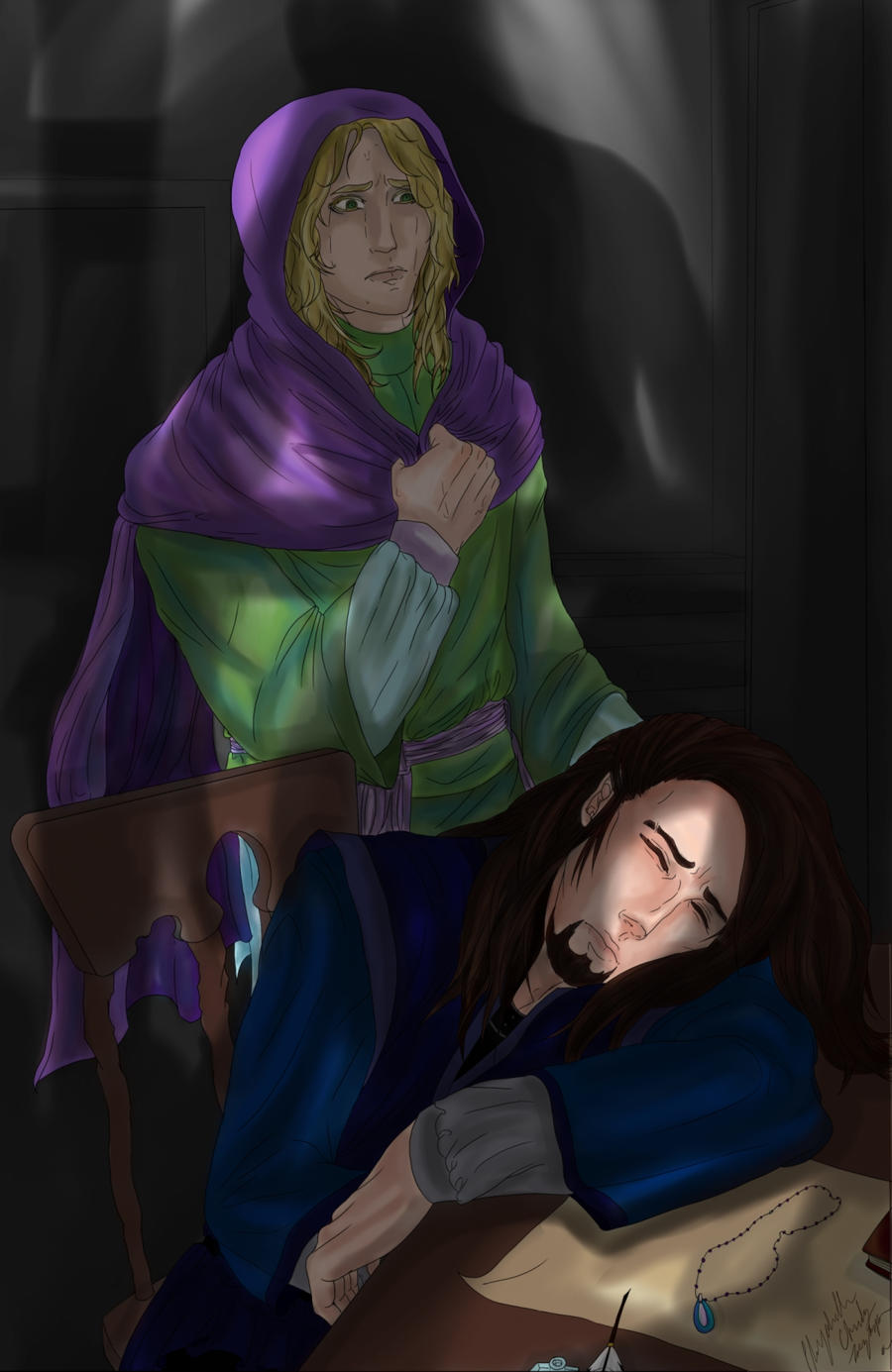
(c) Elizabeth Kelly - ToryKasper


Another example is one of my fantasy characters, Thei, the man in blue sleeping at the desk. This is a character who has hundreds of pages, over a dozen different forms since his creation, and who has grown, and changed and inspired me as a writer a number of times since I conceived him.

This isn't meant to be the most insightful of posts, but a look into my process, and how my characters grow. Sometimes I'm lucky enough to be able to visualize a character in my mind who doesn't need any outward attention to be easy to convey. Another of my collaborative works with Skoora is one of the few exceptions with my character Hal, who quite literally created himself and did and does whatever he wants. For a writer, this kind of character who can act on his own, remain consistent, but also grow, that is ideal. The sad truth is that this is often not true of many characters, and typically they need a nice nudge. Many writers do this through creating playlists, some watch movies, many (well most) read, and some of us draw.

So this brings me to my usual question. How do you find your inspiration, what ways really help you see your characters and inspire you to write? Do you have any suggestions to share?

Saturday, March 9, 2013

Notes on Dystopia

At the Solstice MFA Winter Residency, I attended a class on writing Dystopian literature taught by the wonderful Laura Williams McCaffrey.  We discussed a few novels during the class (The Drowned Cities by Paolo Bacigalupi and 1984 by George Orwell) and delved into some of more intricate characteristics of Dystopia.


Firstly, we discussed the idea that there is no such thing as objective time.  It is relative in every way (the experience of time), regardless of the ways we have discovered in measuring it.  When you extract all rigidity from time itself you open yourself up to alternative time-lines and alternative nows.  In one 'now' you are married, in another 'now' you are not.  How many nows, how many yous?  The possibilities are endless.  The alternative nows are what Dystopia is all about.  True, these stories are often placed in the future, but that is a future that 'could' happen in the now, or a future that the 'now' is helping to create, or, most vitally, it is a now that is already happening this very moment, but we just don't or won't realize it.  In Bacigalupi's story, the backdrop of war and child soldiers is terrifying and upsetting, but it is also a reality: In several parts of the world, there are children who live this life everyday.

Dystopia is a juxtaposition of the possible and the actual, the future and the now, the there and the here.  It is wrought with all the things that keep you up in the night.  Not just monsters, but broad ideas and abstractions that chill you to the bone.  The goal of this type of writing is to make the strange familiar and make the familiar strange and to upset habituality. Suddenly going to the market place to buy apples becomes a dangerous and alien experience, while searching dead bodies for gold teeth becomes just part of the morning routine.   Dystopia draws its power from destabilizing characters, events, settings, and even language. For more information on this concept, Laura recommends an essay by Charles Baxter called "On Defamiliarization" from Burning Down the House.  Another source, one that I highly recommend, that some might find valuable are Anne Bogart's essays from A Director Prepares.

In terms of the overall concept of a story, it should be rooted in something concrete that your audience can relate to or at least understand.  Essentially, find the Hurricane Sandy in your story and make people respond to your abstract idea.  Think to yourself, what might be the worst outcome of 'now,' and study history and human nature because plausibility is what makes Dystopia such a frightening genre.   Study regimes, dictators, and hegemonic power systems.  Ground the 'now' of your novel with the horrors of things that have already happened.  And never forget that your characters are the key.  Put your main characters in the center of the problem, don't skirt around the society through the eyes of a casual observer.  In 1984, the main character works in the records department that allows him to see clearly all of the corruption and censorship around him that others might not be privy to.  In The Drowned Cities, the characters are directly caught up in the conflicts of the war lords and the direct fallout of unsuccessful peace keeping missions.  Show us this unrecognizably familiar new world from within.


Amanda LaFantasie (Skoora) © March 2013

Saturday, March 2, 2013

Craft Choice: Point of View

When composing a narrative, one must examine point of view.  There are many different types, some of these are rather common while others are obscure and typically only attempted by the masters of craft.  This is meant as a refresher for POV since most of us, if not all of us, are familiar with and have written in the vast majority of different POVs.
  • Third Person Limited: 'he' or 'she' is used to denote a POV character and it is through this character that we experience the story.  We see through his/her eyes.
  • Third Person Unlimited or Multiple: the POV character changes throughout the story usually by chapter.  In one chapter we experience things through character A and then in the next we experience it through character B and so on.
  • Third Person Omniscient: it still uses 'he' and 'she' but now the narrative voice is above and beyond a single character.  We see through the eyes of every character and 'head pop.'  It can be difficult to do this and keep the audience clear and who's head we are in and when.  
  • First Person: 'I' is used and the POV character is the narrator.  
  • Second Person: 'You' is used and the narrative tells 'you' what to do or what you are feeling.  This is mainly used in 'how to' type writing and text books.  The choose your own adventure tales also employ this technique.
These are the building blocks of narrative and once you learn to use them, you are more than welcome to abuse them.  Mix it up!  Jonathan Stroud's Bartimeaus Trilogy employs the use of third person multiple as well as first person depending on which character's head we are in.  

In college (undergrad) I had a professor who stated most adamantly that female authors should only write from the POV of female characters and male authors should only write from the POV of male characters.  He also said that most, if not all, stories should be written in third person limited and keep with one character throughout the entire novel.  Recently, during grad school, I met several accomplished and aspiring authors who awakened me to the freedom we have in writing.  They encouraged me to play with POV and also reaffirmed my belief in the commonality of human experience, a.k.a women can write men and men can write women.  For me, being given a sort of permission to mix up POVs and play with alternating POV characters in a story, was extremely liberating.  I encourage our contributors and readers to never feel limited in delivery.

Please visit the following sites for other definitions and explanations of POV: The Beginning Writer, Humboldt.Edu, and Learner.Org.  For further discussion on this topic, comment below!


Amanda LaFantasie (Skoora) © 2013

Sunday, November 11, 2012

PROMPT - Take it outside: Scene Exercise


(all images used are free domain)

One of the hardest challenges for writers is capturing landscape.  Because landscape is so much more than just trees and hills. Landscape has shape, colors, facets, and smells. Landscape has atmosphere. You can take as much from the landscape as you can a character, and you can use that landscape to characterize said character.  So I come with a challenge for all of you.

Take it outside. This can be either figuratively or literally.  If you don't want to go outside, because I know it's cold with winter looming, find a photograph and just look at it for five or ten minutes. Take in the way the light filters through leaves and branches, or how the breeze seems to have lifted the leaves even though you can't feel it. How does the grass sway. Is there a path? How does it look? Mountains, are they jagged and covered in snow? Or are they smooth and dusty? Once you find a landscape that pulls to you, start writing, write anything, anywhere, but make sure you have a character. Use the land to characterize said character.  How does your character feel in the landscape, how does he/she walk or move within the land. What do they look like within the land? Does the land compliment them or distress them?

If you can, because I'm not a stickler for literary fiction, bring mythological or magical elements in. How does the land itself accept this character. Are there challenges keeping the character out, or is it trying to bring her/him in? The point is, use the land in a way you might not usually. Make the land your primary focus in this scene. Let the land build your character rather than the other way around.

Most importantly though, have fun with it!

I am going to do this prompt later today, and in the near future I shall share my results.


Some keywords to get you started: Towering, light, rainbow, silhouette, wispy, shadow, darkness, frail, firm, stagnant, glistening.

Helpful hints: If you can, use metaphor to build your landscape, or even personification. Make the land a character in itself. 

~ Beth


Saturday, September 22, 2012

The self editor at work: Writer Vs. Grammar: The Fragment

     How does one go about editing their work? I know people who will edit as they go. There are a few who wait until they are done. Then there are those who write one draft, call it perfection, then whine when others find many issues.

     I edit as I go most of the time. Then I read through once I'm done, then I email it off to people who know better than to say: "Wow, this is the most brilliant thing ever!" I am horrible at catching the little things. I have a tendency to add letters to words: and instead of an; that kind of thing.

    Grammar? I can honestly leave it. I ignore a lot of things that come up during grammar check. I am not writing a term paper or thesis, therefore, I do not care if I have a fragment. Especially when writing dialogue, or when I am in a character's head. It's not that I don't think grammar is unimportant - it really is. But I find that there has to be leeway when writing fiction - urban fantasy is what I am doing at the moment.

     If I was writing an epic tome of literary abandon, or writing a technical paper or manual, then I would really hunker down on my grammar. I would not have as many - if any -  fragment sentences. I know a couple of professional tutors that would absolutely cringe at some of the stuff I write. Because according to them, (male and female) there is no reason to not follow the rules of grammarians everywhere. I happen to disagree. I do not write for the academic masses anymore, nor am I trying to write the Great American Novel.

     I have gone out of my way to split my infinitives, misplace modifiers, and so on. But, my writing is heavy on the dialogue. And characters do not speak perfect grammar. Sometimes they don't even use the right words. But I feel that is what makes characters more identifiable, more realistic.

     Now, there is a difference between completely foregoing all grammar rules and bending a few here and there. I like to bend. And when the people I have reading my work give me their thoughts and critiques, grammar is never an issue. Sure, there might be one or two things that I didn't catch the first few rereads, but all in all, it is not that big a deal. Most of the feedback I get deals with issues that I have brought up myself.

    I know that having a degree in writing and literature makes people think that your writing should be flawless. No writing is. And there are many well known authors who make grammatical errors. So, when you are asked to read someones work, or are in the process of editing your own, take care in how you address what you think are grammatical errors. Remember the genre you are reading, as well as the way the writer goes about telling their story. Not every rule applies to every piece of writing.

     So, as I get ready to edit the novel I have been working on, I have to keep this in mind. I will make the best effort I can to catch all of the added letters, the weirdly worded sentences, as well as the parts where it becomes obvious that I was half asleep when I wrote it. Because, when you feel that you have done your best, that is when to let your baby have a sleep over at a friends and hope that everything goes the way you want.

Wednesday, August 22, 2012

Generators, Name Lists, and Dolls! Oh, my!


I would like to talk about randomness for a moment.  First, nothing is truly random - even when we seek names, numbers, and coin flips from random generators there is some higher artistic power at work that we humans are too puny to comprehend.  Yes, I really just said that.  Secondly, when a randomly generated name or number or color or whatever is presented to us, it forces us to make a choice and therefore our choice takes away the randomness because suddenly we have ascribed purpose to whatever it is that we have decided.  Do I want Chinese food for dinner or American?  My friend randomly shouts out, "American!"  And because a choice has now been set before me, I can say with full confidence that, no, I actually wanted Chinese food.  Canton here I come!  It is the same way with random generators on the internet.  I put in that I want an Arabic male name and I am presented with one.  I now choose whether to accept it (along with all the instant images and ideas that come along with it) or reject it and press the generate button one more time.  Even if you limit yourself and say 'I will press the generate button once and whatever comes up is what I shall use' you are still making a choice.  You will use that name, research that name, glorify or slander that name, and make a character to be the perfect match or foil to that name.  

In this post I have included random generators (as well as already generated name lists) that I have used in the past.  What I would like to know, is if you find such things to be enormous wastes of time or if they help you in developing characters in some way.  Do they at least help you decide what not to do?  Further down the list I have also included generators and visual aides that might help with the design of the character and even the setting in which they might live.  I find such things to be very useful in some situations (not all).  More often than not, room design and dress up games are just a starting point for me, and then my own imagination and creativity take over.  Could such things end up being distractions from the process?  Try a few out perhaps and then decide.  And of course, it always depends on the situation.

  • Name Generator Index (A list of generators that provide you with everything from Hillbilly names to names for your pony.)
  • Fantasy Name Lists (A branch of the previous site wherein you can find links to various fantasy name lists, a few fantasy specific name generators, and also the 100 most essential words in anime - talk about random O_o.)
  • Names Master List (Another branch of the same site with a plethora of links to name lists for pretty much anything you could think of to name.  If it isn't there, it doesn't deserve a name.)
  • 20,000 Names (A personal favorite of mine and Crimson Lantern.  This is also linked to this very blog.  It is a very informative and well categorized name database for practical and fantastical use.)
  • Fantasy Name Generator (Just push generate and you'll have a whole slew of interesting and unique names and if you don't like what you see, refresh the results page for more names.)
  • Pet Names (as in lovey dovey, not for Fido) (If you have a character who likes to say things like 'sweetie pie' and 'pumpkin tits' this might be a good place to find inspiration.)
  • New Identity (This site generates a new name and a whole new identity for you - should you need one  O_O - or can be a good starting place for a character.  I used it to create a new identity for a character who went into witness protection.)
  • Random Name Generator (This site is similar to the last one but with a less intense tone.  You can generate based on ethnicity or even race of magical creature.)
  • Character Name Generator (D&D) (A place to go if you want some creative names for your Dungeons and Dragons characters, or novel characters who merit such names.  Kind of fun.)
  • Noemata (I have used this over and over again - it basically pumps out random collections of letters and syllables that are without trademark.  It is a good place to look up fake brands for stories or to seek inspiration for cyber-punk or fantasy names.)
  • Random.Org (If you are debating on having your character go left or right - this is a place where you can flip a virtual coin or pick a number between X and Y.  You can also roll the dice.  It's nice if you don't have coins and dice handy and would like to practice randomness in your decision making.)
  • D&D Dice Roller (Because I felt like I couldn't leave it off after the last entry.  If you need to know how badly your poor character took a beating in that alley last night and you want help deciding - just roll a D20 and let the carnage begin.)
And, as promised here are some other random things that may or may not help you along your way to creativity and production.
  • Elizabethan Insults (The name really says it all.  Included in this site is a link to an Elizabethan insult generator above and beyond what is already presented. Good fun.)
  • Fantasy Dress Up Index (A whole slew of dress up doll games that could give you ideas for clothes, looks, locations,or even anthropomorphic additions to your characters.)
  • Doll Divine (The site I use more than others to find dress up doll games for male and female characters.  You can screen shot your final creations and tuck them away for further inspiration.)
  • Room Sketcher (Design your, or your character's, dream house and give yourself a good visual of where things are located about the house so that you can describe it easily in your writing.  I haven't used this site very much at all, but I know others who have found it pretty helpful.)
Randomness is something that writers all come to embrace.  Dani posted picture cubes as a writing prompt, others toss word dice to come up with a plot.  Some people put names, places, and activities in three separate hats and pull out the makings for a writing exercise or story.  There was a musician (a composer) who used to walk around naked then lay on his piano and pound the keys randomly until inspiration struck.  It all seems so random and yet it is all a choice.  Choose randomness.  That is one way to keep the creative juices flowing.   In closing, here is a link to Script Frenzy's plot machine: Script Frenzy.Org.  Script Frenzy (a sister branch of NanoWriMo) is no longer an event, but the site remains intact for people to make use of their script writing tools which include this plot machine.  Randomness in motion.  If anyone has any generators or lists that they have found useful in the past, I would love for you to share them with me.  And if you have any creative prompts that hinge on randomness, please share those as well.

Amanda LaFantasie (Skoora) © 2012