This is a topic I might have already touched upon, however I wanted to revisit it. If I have not mentioned it on Detangled Writers, or if I have and you just don't want to scroll a dozen pages back, I will start by asking you all a question: What does it take to make a story? Not a good story, not an amazing story, or even a bad story. Just a story, the rest can come after; and why am I asking you this? Because this is a topic that is both intriguing to me, while being irksome at once.
We have many expectations for a story, some of them very shallow. I'll name a few, a story must have plot, and it must be reasonable, that's one expectation - or often considered requirement. A story must have characters, and those characters need to serve a purpose. A story must have meaning, not necessarily a lesson, but meaning that relays to the reader. And that leads to the most shallow of expectations (in my opinion), a story must be written - or oral, but it must be made of words.
This expectation has often baffled me, as a person who can sit and stare at a piece of artwork, or listen to a classical work of art, and wonder and imagine and build from them. Yet many people are very adamant that such things as music or artwork are not stories. Do you believe this is true? In one of my writing courses we had a very heated debate on what a story was, and most people attested that no, a story had to be a full manuscript, but it could not be a picture or any form of artwork.
I believe this to be a very narrow view, and as a writer, as an artist, as someone who loves listening to music, I wanted to share this idea with you all. I was one of three people that contested this view of storytelling, and here is why. All of my stories, start with pictures, start with a feeling that I'm having inside, because that's my outlet, and so when I was told that art was not a form of storytelling I was quite offended, because this is what I believe a story is.
Anything that can get your imagination invested. As simple as that. I believe that if you look at a picture, and you ask 'why?' there is a story there, because as soon as you ask why, your mind starts building that story for itself. The artist who painted the picture, there was an investment in the presentation, there was a thought, and as an artist myself, there is a story, at least for me, even if it's missed by everyone else.
Now I know that's a very broad view, and can be equally as dangerous as the narrow view of story, so I'll condense it into a smaller frame of idea. Native Americans and Ancient Egyptians often used pictures to depict their legends where words and language were not enough. Would we deny that these are stories?
Finally the definition of story that really bothered me was that a story must have length:
"For sale, baby shoes. Never worn."
- Ernest Hemingway
This is the story that Hemingway considered his very finest in it's power to invoke a reaction. He believed this to be his greatest work of all time, and many people say that this is not a story at all. They say it's a piece of prose, but that it lacks the length and meaning of a story. It lacks the meaning? Do you believe this is true? "For sale, baby shoes. Never worn." This lacks meaning? ...Never worn; why? Why were these shoes never worn. Considering Hemingway's time, it leads to the assumption that the child died, if the child didn't die, there was something amiss with the shoes, but either way, there is a distinct feeling of loss - at least to me.
Because of the contention against this piece, a form of writing known as flash-fiction was created, and in fact my limited research on the topic genuinely suggests that this is the very reason flash-fiction was created at all. However flash-fiction doesn't necessarily make it a story. I admit I don't believe this is probably Hemingway's best work, but the fact that it resounded so strongly with him, and that he believed it to be his best, doesn't that investment in and of itself make it a story? Of course Hemingway knows much more than any of us behind the true meaning of the story, because perhaps the shoes were just too small for the baby, we don't know, it leaves us to wonder though.
So I want to ask all of you, what do you think qualifies as a story? Do you think it's an underlying meaning, or does it have to have words and length? Do pictures and songs count? Or is it what comes after that counts?
Showing posts with label art. Show all posts
Showing posts with label art. Show all posts
Monday, July 22, 2013

Sunday, May 19, 2013
A Writer's Journey - Art as an Inspiration

(c) Elizabeth Kelly (ToryKasper) & Amanda Lafantasie (Skoora)
Oh, it feels good to be back. I apologize for my recent absence. I was cleared by the admins to take a break away from DW in order to focus on my studies at Uni. Well now that the semester is over I make a triumphant return, and for my first post of the summer I want to talk a little bit about inspiration. This is something we as writers are all familiar with, and there are a million and one phrases (probably more) about where inspiration comes from, how we are our own inspiration, and how we use our inspiration.
Many writers (including myself) find inspiration from music. There are many other forms of inspiration though, and I thought it might be prudent to talk a little about my own writing process, and how I work through the pages. It's quite a simple issue, while being altogether complex. Let me explain this in one word. Illustration. In many ways I differ from most artists, who have an image in their head that they get down onto the page through words. My inspiration comes first from my artwork.

(c) To Elizabeth Kelly - ToryKasper
For example. This is a picture that I drew, that started one of the most in depth stories I've ever written, coauthored by Skoora (Amanda Lafantasie). this is only one example of how a picture has influenced one of my stories. I often will struggle with what to write, my imagination not as vividly connected to imagery as many of my fellow writers. So I put my thoughts down onto the paper in another way, and from a picture, even a simple one like this one, a story blooms. Sometimes the pictures are simple, sometimes they are more complex, but their purpose is always the same. In terms of a chemical reaction, an enzyme is used to speed up the process, to create a stronger reaction between chemicals, and this is what my artwork does for my stories.
Typically, I have an idea, but then I struggle with how to represent that idea. How do I describe this character? How do I show this scene in words? In what way can I bring setting to life. When I cannot answer these questions easily, I'll turn to my sketchpad or my art program and I'll start to sketch. The characters with my greatest characterization are those I've drawn in scene. The picture above is my namesake character, Tory. He was first built off of a picture too horrible to share, but fundamental in his original concept. From that one picture over a thousand of pages of writing has been born; both collaboratively and on my own. Through out the years since his conception (seven to be exact), he has evolved, changed, moved, and regressed a number of times. He has revealed to me a different part of him, and always through artwork.
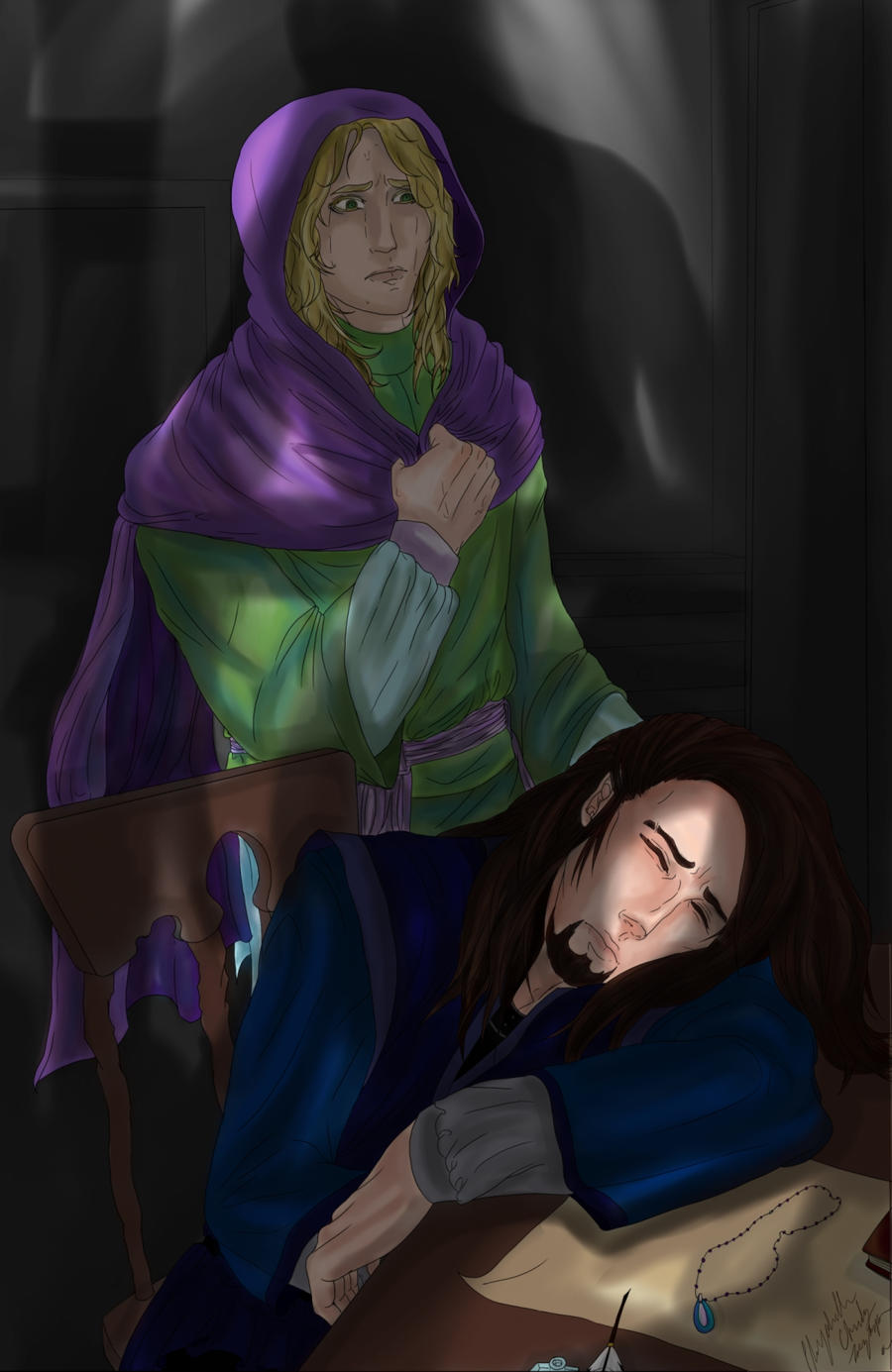
(c) Elizabeth Kelly - ToryKasper
This isn't meant to be the most insightful of posts, but a look into my process, and how my characters grow. Sometimes I'm lucky enough to be able to visualize a character in my mind who doesn't need any outward attention to be easy to convey. Another of my collaborative works with Skoora is one of the few exceptions with my character Hal, who quite literally created himself and did and does whatever he wants. For a writer, this kind of character who can act on his own, remain consistent, but also grow, that is ideal. The sad truth is that this is often not true of many characters, and typically they need a nice nudge. Many writers do this through creating playlists, some watch movies, many (well most) read, and some of us draw.
So this brings me to my usual question. How do you find your inspiration, what ways really help you see your characters and inspire you to write? Do you have any suggestions to share?
Subscribe to:
Posts (Atom)