I'm going to write every day this year. I'm going to get out one of my old journals and put a few lines down. If I write a blog or write on a novel, my entry might just be 'see blog' or 'Death Man 300 words' or what not. I need to write. That is my life blood right now. I need focus. And any writing, no matter how serious, how decent, how pathetic, or how bland, is better than no writing.
Amanda LaFantasie © (last day of) 2013
Showing posts with label creative writing. Show all posts
Tuesday, December 31, 2013
Thursday, October 31, 2013
NaNoWriMo Time!
It's that time again! National Novel's Writer Month, or NaNoWriMo, is here. It starts midnight tonight. I know that several members of this blog are going to be taking part this year and I thought we could do a mid month check up to see how everyone is doing and how far along they are to their 50 thousand word goals. To kick it off, I'm going to stay up and start writing in the wee first hours of November and see if I can get a good five hundred in before I crash for the night. My goal is to work on new material for my Death Man novel as well as get a start on a new novel that can work as my workshop pieces for the upcoming winter residency where I will be starting my third semester with Pine Manor College's Solstice MFA in Creative Writing.
A word of advise from me for all those out there attempting this wonderful and exciting task: make time. Steal minutes wherever you can. Even if you just have fifteen minutes between things and you think you have enough quiet or concentration to pump out a few paragraphs, then do it. Every little word counts. A book is nothing but chapters and chapters are made of pages and pages are made of paragraphs and those paragraphs are made of sentences and that's where words come in. They are the foundation of everything in literature. Keep the words coming and don't stop to edit (or at least don't stop for too long). Best of luck to my fellow NaNoWriMo participants. Ready, set, write!
Wednesday, October 30, 2013
The Importance of Imagery
This is my craft analysis for my MFA on imagery using Deliverance by James Dickey as the main source. You do not need to have read the book to read this essay and I do not believe there are any real spoilers contained within. Enjoy!
Gardner introduces the
concept of the originality of the writer’s eye in On Becoming a Novelist. Essentially, “Getting down what the writer
really cares about – setting down what the writer himself notices, as opposed
to what any fool might notice – is all that is meant by the originality of the writer’s eye”
(Gardner 71). The above passage is a
great example of that originality. This
isn’t just a river anymore; it’s Dickey’s river. It’s Ed’s river. Through his narrator, Dickey captures things
about this river that are different from ‘what any fool might notice’ and uses
these things to develop his survival theme.
Ed’s life before the river begins to merge with his life now: “outlining
a face, a kind of god, a layout for an ad, a sketch...” He sees the face of a god in recognition of
the divine power of nature and he relates it to things he knows from his job,
from his life before the canoe trip.
Only this character, presented
by this author, could view things
this way. That is the power of imagery
and the originality of the writer’s eye.
Burroway, Janet, and Susan Weinberg. Writing Fiction: A Guide to Narrative Craft. New York: Longman, 2003. Print.
Dickey, James. Deliverance. Boston: Houghton Mifflin, 1970. Print.
Gardner, John. On Becoming a Novelist. New York: W.W. Norton, 1999. Print.
Scofield, Sandra Jean. The Scene Book: A Primer for the Fiction Writer. New York: Penguin, 2007. Print.
Imagery in the
Georgia Wilderness
Some say
the devil is in the details, but when it comes to imagery, I say the
‘difference’ is in the details. Imagine
a picnic scene. Vivid, sensory
descriptions are all that stand between a Monet-esque
afternoon, and the third circle of Dante’s hell. On one hand we have gently swaying ash trees,
rolling grasses, polished silver with scalloped edges, and starched, white
doilies; on the other we have a threadbare blanket, an overcast sky, enormous
deep-fried turkey legs, an ant army descending upon a glob of jelly, and greasy
fingers digging into the basket for more.
Could very well be the same picnic, but the images give us vastly
different impressions. These
descriptions not only color our perceptions of scenes, they give us a deeper
understanding of the novel as a whole, particularly its theme.
In the
novel, Deliverance, James Dickey reinforces the Darwinian theme –
survival of the fittest, or, you have to adapt or you die – through his use of
sensory and emotional imagery. Janet
Burroway tells us in her book, Writing Fiction: A Guide to Narrative Craft, “... if you are to
realize your characters through detail, then you must be careful to select the
details that convey the characteristics essential to our understanding. You can’t convey a whole person, or a whole
action, or everything there is to be conveyed about a single moment of a single
day. You must select the significant”
(Burroway 78). This goes back to the imaginary
picnic. If the theme is ‘rich people are
slobs and pigs on the inside’ wouldn’t it be better to use the latter
description over the former? Of course
that depends on the context of the rest of the novel. Looking at Deliverance, which is a
story about survival at great physical and emotional costs, it would be strange
if the narrator, Ed, who happens to be a novice hunter, only noticed fluffy
tails, wiggling noses, and cute features when encountering animals. Those details have a time and place, but not
in this novel. The imagery in the
following passage is what separates Dickey from Disney.
“In the middle of this sound the
tent shook; the owl had hold of it in the same place. I knew this before I but the light on – it
was still in my hand, exactly as warm as I was – and saw the feet with the heel
talons now also coming in. I pulled one
hand out of the sleeping bag and saw it wander frailly up through the thin
light until a finger touched the cold reptilian nail of one talon below the
leg-scales. I had no idea of whether the
owl felt me; I thought perhaps it would fly, but it didn’t. Instead, it shifted its weight again, and the
claws on the foot I was touching loosened for a second. I slipped my forefinger between the claw and
the tent, and half around the stony toe.
The claw tightened; the strength had something nervous and tentative
about it. It tightened more, very
strongly but not painfully. I pulled
back until the hand came away, and this time the owl took off.
All night the owl kept coming back
to hunt from the top of the tent. I not
only saw his feet when he came to us; I imagined what he was doing while he was
gone, floating through the trees, seeing everything. I hunted with him as well as I could, there
in my weightlessness. The woods burned
in my head. Toward morning I could reach
up and touch the claw without turning on the light” (Dickey 89).
Nothing is
fluffy or friendly about this owl.
Dickey uses words like ‘reptilian,’ ‘stony,’ ‘claw,’ and ‘scales’ to
describe an animal that, in a different setting, might be considered cute. The image Dickey creates is that of a fit and
efficient hunter, everything that Ed wants to be, and, in the end, is forced to
become. In On Becoming a Novelist
by John Gardner, the author says that “... the writer who works closely with
detail – studying his characters’ most trivial gestures in the imagined scene
to discover exactly where the scene must go next – is the writer most likely to
persuade and awe us” (Gardner 37). So
much happens in this small scene where Ed touches the owl. Through his “most trivial gestures” we
understand, or have an idea, of what has to happen next. Already we see Ed adapting himself for
survival: “I hunted with him as well as I could,” and, “I could reach up and
touch the claw without turning on the light.”
Sandra
Scofield reminds us in her book, The Scene Book; A Primer for the Fiction
Writer, to, “... keep in mind that you want details to be part of action,
not tacked on for effect. And do
remember to engage all of the reader’s senses, not just sight” (Scofield
112). The owl passage focuses more on
touch than it does sight, but an even better example of “... integrat(ing)
description – mak(ing) it a part of the flow of the action of the scene ...”
(Scofield 111) occurs during a confrontation between the protagonists and two
men who, “... stepped out of the woods, one of them trailing a shotgun by the
barrel” (Dickey 107). The climax moment
of this confrontation occurs in sounds:
“I knelt down. As my knees hit, I heard a sound, a snap-slap
off in the woods, a sound like a rubber band popping or a sickle-blade cutting
quick. The older man was standing with
the gun barrel in his hand and no change in the stupid, advantage-taking
expression of his face, and a foot and a half of bright red arrow was shoved
forward from the middle of his chest. It
was there so suddenly it seemed to have some from within him” (Dickey 116).
While
Burroway tells us, “A detail is ‘definite’ and ‘concrete’ when it appeals to the
senses. It should be seen, heard,
smelled, tasted, or touched” (Burroway 75), Dickey often creates images using a
combination of abstract and sensual details. In the following passage there are a number of
details that help us see the river on its surface level, “... as if [we] were a
movie camera” (Gardner 71), but we also see it as Ed sees it, as something
mindless, indifferent, and uncomprehending.
“What a view, I said again. The river was blank and mindless with
beauty. It was the most glorious thing I
have ever seen. But it was not seeing,
really. For one it was not just seeing.
It was beholding. I beheld the river in its icy pit of
brightness, in its far-below sound and indifference, in it large coil and tiny
points and flashes of the moon, in its long sinuous form, in its
uncomprehending consequence. What was
there?
Only that terrific brightness. Only a couple of rocks as big as islands,
around one of which a thread of scarlet seemed to go, as though outlining a
face, a kind of god, a layout for an ad, a sketch, an element of design” (Dickey 171).
One of the
lengthier scenes in Deliverance depicts Ed climbing a mountain cliff. It is a simple enough action: man climbs
mountain. But the massive amounts of sensory detail that go into the scene’s
composition turn it into an intense conflict of man versus nature.
“I got on one knee and went cautiously
outward, rising slowly with both hands palm-up on the underside of the fissure
top. I was up, slanting backward, and I
felt along and around the bulge over my head.
To the right there was nothing I could do, but I was glad to be
back. To the left the crevice went on
beyond where I could reach, and the only thing to do was to edge along it, sidestepping
inch by inch until only my toes, very tired again, were in the crack” (Dickey
175).
“Time after time I
lay there sweating, having no handhold or foothold, the rubber of my toes
bending back against the soft rock, my hands open. Then I would begin to try and inch upward
again, moving with the most intimate motions of my body, motions I had never
dared use with Martha, or with any other human woman. Fear and a kind of enormous moon-blazing
sexuality lifted me, millimeter by millimeter” (Dickey 176).
What starts
out as ‘man climbs mountain’ turns into ‘man f***s mountain.’ It makes sense in a way. There is an enormous amount of risk and
physical exertion involved in climbing and in love making and Dickey uses this
relationship between activities to not only create a visceral image for the
reader but to also how Ed’s development in becoming a survivor. Scofield says, “... ‘description’ isn’t a
discreet element in narrative” (Scofield 111), and there is certainly nothing
discreet in Ed’s triumph over the mountain:
“It was painful, but I was going.
I was crawling, but it was no longer necessary to make love to the
cliff, to f*** it for an extra inch or two in the moonlight, for I had some
space between me and it” (Dickey 177).
The
example of the picnic from the beginning gives us a taste of the spectrum of
choices an author has to make when writing imagery into a scene, but Dickey’s
text shows without a doubt the importance of making the right choices. In The Scene Book, Scofield says, “Forget
those high school classes where you talked plot, setting, character,
theme. Those things aren’t
separate! You want your descriptions to
exist as part of action and emotion, part of the meaning of your scenes”
(Scofield 111). Imagery is just one
piece of the puzzle. It’s a piece, if
done well, that is entirely unique to each author,
and even each character, and it’s the one that makes all the
difference.
Works Cited:
Burroway, Janet, and Susan Weinberg. Writing Fiction: A Guide to Narrative Craft. New York: Longman, 2003. Print.
Dickey, James. Deliverance. Boston: Houghton Mifflin, 1970. Print.
Gardner, John. On Becoming a Novelist. New York: W.W. Norton, 1999. Print.
Scofield, Sandra Jean. The Scene Book: A Primer for the Fiction Writer. New York: Penguin, 2007. Print.
Amanda LaFantasie © October 2013
Saturday, August 17, 2013
Hannah's (Crimson Lantern's) new goal list.
The lovely Amanda LaFantasie last posted this blog's anniversary (which is amazing! Great job everyone!) and also about old goals and new. So here I am, reviewing my old list and compiling a new list.
Old list:
1. Finish a book
2. Improve spelling and grammar
3. Be more descriptive
4. Write more elegantly and eloquently
5. Get something published.
6. Improve writing habits/ setting word goals
New List:
1. Finish a book! I get so fixated if something doesn't feel right that I end up derailing myself.
2. Work on letting go of the small stuff and moving forward in a story.
3. Be more descriptive but don't bash it in. Sometimes less is more and learning the balance is key.
4. Writing more elegantly, sure, but writing gritty as well
5. Improve writing habits. This is the hardest of all but I will explain that later in another blog. Setting word goals aren't really a concern of mine at the moment. I am happy to write a paragraph at this point. Again, I will explain later.
6. Balance out my reading list. I need to read more fiction and less non-fiction.
7. Getting feedback. Again this is another blog post entirely, but it is just as important as anything else. 8. Make it worse, make it hot! Something Amanda's current mentor from Pine Manor College, Sterling Watson, said. Some of the best advice I have ever heard.
Friday, August 16, 2013
Happy Anniversary: Looking Back and Looking Forward
As I was perusing the blog today, I noticed that it's been a year since we got this craziness going! Our official anniversary was the 13th of this month, but we'll celebrate it a few days later because I definitely feel it's worth celebrating. Firstly I want to congratulate everyone who has been a part of this blog, the admin, the writers, the editor, and the readers. I know that for me, Detangled Writers has been a source of pride, enjoyment, and education. Taking a look at our contributor profiles, I see a group of people who I hold in high esteem. These women have taken time out of their lives to share their thoughts and knowledge with the writing community. Some of the goals we wrote in our profiles might be a bit outdated by now - some things might be all done and checked off, some things may have been set aside, while others may be in progress. I invite the contributors to create fresh goals lists and provide an update. Tell us about your writing; what projects do you have going on, is writer's block bugging you, are you having trouble finding time for your craft? Also, let's talk about what goals we have for the blog in general and how we can become an even better support network for each other.
Old Goals for Amanda LaFantasie (Skoora)!
- Time Management
- Keeping the Creative Juices Flowing
- Finishing what I start...
- Grad School and everything to do with it!
- Characters - working on characterizations
I accomplished part of number four by applying to and being accepted to an MFA program. I am currently working toward completing my masters in creative writing at Pine Manor College. Number five can be removed because, for me, the writing itself is what generates character and plot and trying to work on those independently is possible but not really a goal. As far as the first three goals, I would keep one and three on my list! Number two is less of a goal for me and more a goal for the blog. My new list, a much more specific list, would look like this:
New Goals!
- Time Management
- Finish Death Man (my current novel in progress)
- Work on short stories for Workshops
- Read craft books and fiction novels
- Attend an AWP conference (Seattle 2014)
Some goals for the blog would be to see some more blogs on hot topics such as fanfiction writing, romance versus erotica, elements of craft, literary definitions and analyses, and even book reviews and discussions. I would love to see more vocab words! Everyone is encouraged to post vocab builders and word exercises. If people have personal blogs where they share writing pieces, I would like to see entries detailing the process, successes, and failures they had with the project and then a link so we can read your work.
I hope that everyone who is part of this blog is as proud of it as I am. This post brings our total to 148 published blogs for Detangled Writers. Here's hoping that by this time next year we have upwards of 300! Thank you to our contributors and readers.
Labels:
Admin,
books,
characters,
Contributor,
Craft,
creative writing,
education,
Goals,
links,
MFA,
plot,
Progress Report,
Reading,
short story,
Skoora,
Time Management,
update,
workshop,
Writing
Wednesday, June 5, 2013
Retreat! Retreat!
I want to spend a moment talking about the importance of a retreat where the only expectations put on you are the ones you've put upon yourself. Your goals are all that matter and it is up to you to complete something, polish something, begin something new, or write a million drabbles that make you feel like a complete human being. A writer's retreat is a place where you don't have to worry about dishes or about vacuuming or about who's coming over to dinner tonight or how your hair looks. It's a place where you focus on your writing and on the things that awaken creativity. An ideal retreat, in my opinion, would begin with everyone coming together for some sort of physical exercise (a swim in a nearby lake, playing the human knot game until you finally untangle, red-light/green-light, or even just a nice long hike in the outdoors). Then we would move into something soothing like meditation (guided or personal) and go through a series of long stretches. No matter the person's artistic preference, it is through our hands, our minds, our senses, our bodies that we receive and interpret and create and it is good to keep these things fine tuned.
We would break off then to get to work. It would be for the individual after all. We would make our own schedules and keep them accordingly. I would have meal times listed - that or we would rough it and each fend for ourselves - and we could come together for fellowship and re-invigoration. It would not be a test, competition, or race. Everyone should come with their own goals and work toward them and revise them as they see fit. There may be a communal activity once or twice a day (most likely something physical again and then something more mental). At the end of how ever many days (hours) that we hold the retreat, I think there should be an opportunity to showcase a piece of what we worked so hard on. We could have a reading or we could pass out a packet to look over. This retreat would not have to be limited to writing, though I would suggest special emphasis in this area.
We've had a few ideas thrown around on this site for workshopping and other communal efforts to encourage ourselves and each other to continue working on our goals. I propose a small writer's retreat as a way to generate lots of new material without the distractions of the everyday world. There could even be a workshopping segment of the retreat to help authors who want to polish up their material. What are some thoughts on this? Of course cost is something to keep in mind, but if this were to be something we could do in the summer months, it would be feasible to do a sort of camp out. There are places that have rec rooms with electricity for us to use. Or we could even do a two day retreat and rent out public park spaces such as the one at Kiwanis park where electricity is available. You don't need a large group to have a retreat - it is more than practical to have a retreat of just one. If you can't meet up with fellow writers, you can always pick up some goodies and lock yourself away in a hotel somewhere for the night.
The most important thing of all in these retreats however, is that you have privacy and can remain relatively untouched by the troubles of the real world. This is definitely something I want to look into having. For further information on some already established retreats visit here and here! Or check out this guidebook: here. These are just a few things about retreats, the internet is full of them and with such boundless reference material at our fingertips, it seems a darn shame not to take advantage of having a retreat all our own. Or at least all on one's one.
Amanda LaFantasie (Skoora)
Sunday, May 19, 2013
A Writer's Journey - Art as an Inspiration
(c) Elizabeth Kelly (ToryKasper) & Amanda Lafantasie (Skoora)
Oh, it feels good to be back. I apologize for my recent absence. I was cleared by the admins to take a break away from DW in order to focus on my studies at Uni. Well now that the semester is over I make a triumphant return, and for my first post of the summer I want to talk a little bit about inspiration. This is something we as writers are all familiar with, and there are a million and one phrases (probably more) about where inspiration comes from, how we are our own inspiration, and how we use our inspiration.
Many writers (including myself) find inspiration from music. There are many other forms of inspiration though, and I thought it might be prudent to talk a little about my own writing process, and how I work through the pages. It's quite a simple issue, while being altogether complex. Let me explain this in one word. Illustration. In many ways I differ from most artists, who have an image in their head that they get down onto the page through words. My inspiration comes first from my artwork.
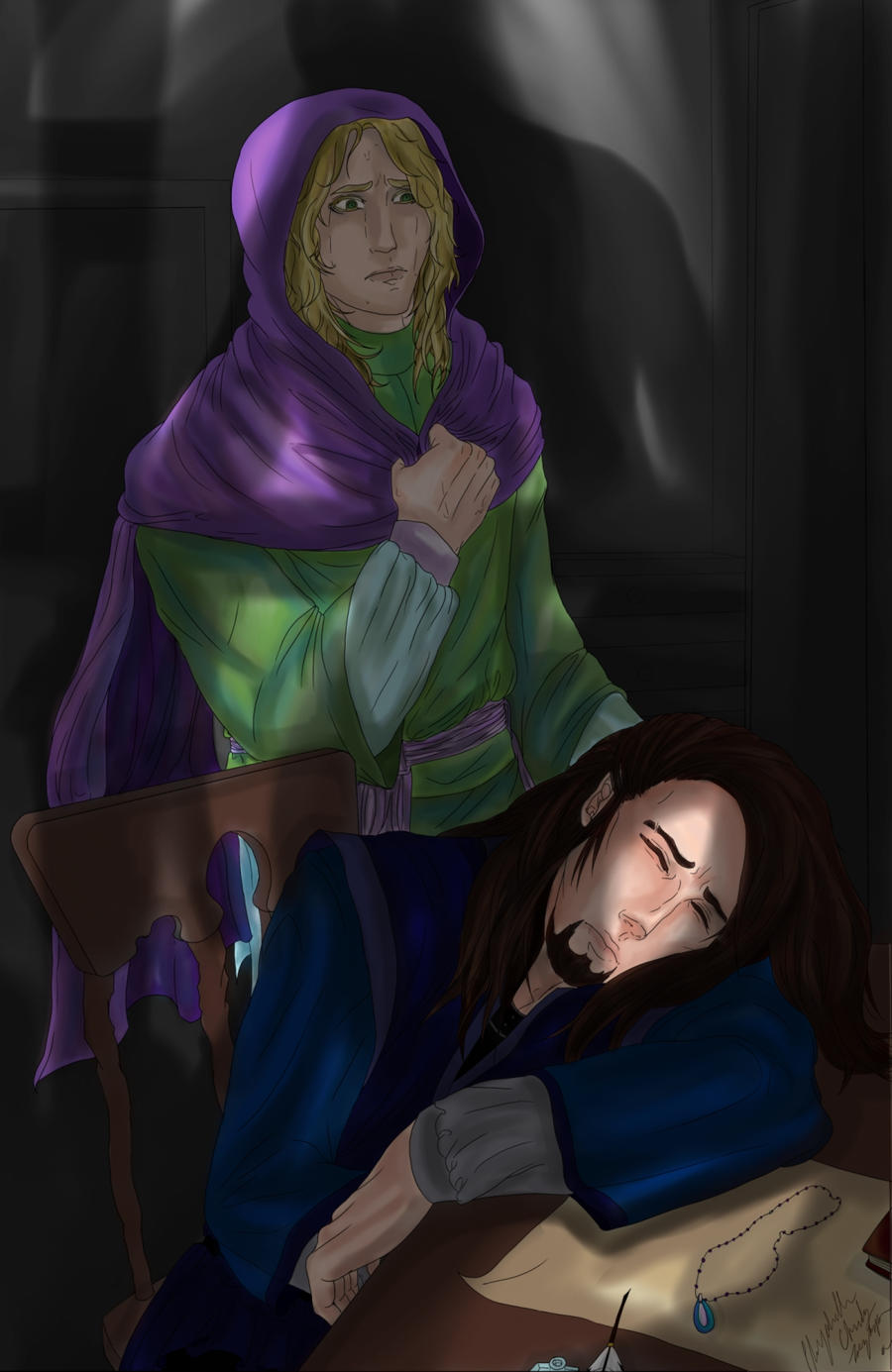
(c) To Elizabeth Kelly - ToryKasper
For example. This is a picture that I drew, that started one of the most in depth stories I've ever written, coauthored by Skoora (Amanda Lafantasie). this is only one example of how a picture has influenced one of my stories. I often will struggle with what to write, my imagination not as vividly connected to imagery as many of my fellow writers. So I put my thoughts down onto the paper in another way, and from a picture, even a simple one like this one, a story blooms. Sometimes the pictures are simple, sometimes they are more complex, but their purpose is always the same. In terms of a chemical reaction, an enzyme is used to speed up the process, to create a stronger reaction between chemicals, and this is what my artwork does for my stories.
Typically, I have an idea, but then I struggle with how to represent that idea. How do I describe this character? How do I show this scene in words? In what way can I bring setting to life. When I cannot answer these questions easily, I'll turn to my sketchpad or my art program and I'll start to sketch. The characters with my greatest characterization are those I've drawn in scene. The picture above is my namesake character, Tory. He was first built off of a picture too horrible to share, but fundamental in his original concept. From that one picture over a thousand of pages of writing has been born; both collaboratively and on my own. Through out the years since his conception (seven to be exact), he has evolved, changed, moved, and regressed a number of times. He has revealed to me a different part of him, and always through artwork.
(c) Elizabeth Kelly - ToryKasper
This isn't meant to be the most insightful of posts, but a look into my process, and how my characters grow. Sometimes I'm lucky enough to be able to visualize a character in my mind who doesn't need any outward attention to be easy to convey. Another of my collaborative works with Skoora is one of the few exceptions with my character Hal, who quite literally created himself and did and does whatever he wants. For a writer, this kind of character who can act on his own, remain consistent, but also grow, that is ideal. The sad truth is that this is often not true of many characters, and typically they need a nice nudge. Many writers do this through creating playlists, some watch movies, many (well most) read, and some of us draw.
So this brings me to my usual question. How do you find your inspiration, what ways really help you see your characters and inspire you to write? Do you have any suggestions to share?
Labels:
art,
character development,
characterization,
characters,
creative writing,
drawing,
inspiration
Wednesday, April 3, 2013
Progress Report for Skoora
One thing that we discussed is narrative authority. I tend to write 'somehow' and 'perhaps' when writing in observant third person and not writing directly from the characters experience. This makes it sound as if I, the god-like narrator, does not know how or why something happens. The character does not know these things, but the narrator definitely does. This is something I definitely want to work on because a vast majority of the stories I want to write will depend greatly upon the credibility of the observer narrator.
This month is a Camp NaNoWriMo month and I am signed up with a 20,000 word goal. Usually I try and crank out the 50K but since the majority of what I am writing right now is coming to me slowly and with much revision and polishing, I figured a smaller goal would be less stressful and much more feasible. I'm curious about my fellow contributors: are any of you participating in NaNoWriMo this month and if so what kind of projects are you undertaking? I am working on my dystopian novel as well as a few short stories that may be lead ins to future novel projects.
© Amanda LaFantasie (Skoora) 2013
Monday, March 25, 2013
Grammar Corner: Forget Grammar
That's what the editor is for! Not to mention the second draft.
Now this grammar suggestion, this one is quite controversial in the writing world, and has been a point of contention between authors and the different schools of writing. However, as far as I am concerned this is one of the most important rules. Allow me to explain.
Grammar is a necessary and innate part of our culture as a writer. This we know. The key word in that phrase is innate. If we want to call ourselves writers, something we are already quite familiar with is the English language (or any language in which you are writing in), and how to use it. We have a lot of practice in the realm of grammar just out of practice alone. We know simple sentences have a noun, verb, and predicate, and end in periods, questions end in question marks, and exclamation marks can be an eyesore when there are too many in unison. We get this and our hands and brain know how to deal with it naturally.
So what do I mean when I say forget grammar?
Simple.
I mean literally, forget it. Not in the sense where you completely disregard it, or go out of your way to make every sentence you write a grammatical fallacy. No, nothing like that. What I mean is simple. Do not let grammar dictate your writing. Do not spend hours and hours letting the sentence structure of one section of your prose keep you stuck for hours because it's just not right. We're all guilty of this, I know I am. When a sentence doesn't flow right, we fixate. Every writer is a little bit OCD in my opinion, and like any OCD it starts to interfere not only with the writing, but the life of the writer.
So forget it.
Now this is easier said than done of course, as is anything with writing. Because we've been trained, no conditioned from a very young age to be very attentive to grammar and grammatical fallacies. We've been taught to worship the academic essay and the 9 sentence structure.
Stop! Right now! Just throw that all out of your mind, because if you're here, you are writing for pleasure, you are writing because it's something you enjoy, because you're embracing something deeper than the academic essay. Any manual can teach you how to write a good research paper, but no manual in the world can tell you how to properly break all the rules and become a New York Times Bestseller.
One of the greatest things about being a writer is the freedom we are given. When we let go of the mental constraints that grammar puts on us, the need to make sure we always use the right word at the right time, the right, right or write, then or than, or even where we put a comma in a sentence. Constantly watching for little mistakes that are easy to spot and edit later, we are inhibiting our natural writing process, and inhibiting our ability to write all together.
And sentence structure, that's another matter all together. We are given all these rules that tell us how to write a sentence, but those rules often lead to dry and frankly boring commentary that wouldn't be fit in a 'How-To' manual. So forget about those rules. Writing is an art form, and one of the greatest achievements an artist can make evolving the art. Many authors have adopted a lyrical or poetic approach to their writing, replacing periods for commas, or quotations with never underestimating the intelligence of the reader. Play with your writing, build on your writing, and worry about grammar later.
Those little mistakes that everyone nags and nitpicks about, those can be edited in the future. But losing your story because you're not able to focus because all the rules are holding you down, that can sometimes be devastating. So just write, and enjoy what you're writing. Grammar, sentence structure, rules; all of those can wait until later.
Note: This is merely the thoughts and ideal expressed by me personally and may not be shared with other contributors on this blog. And remember, editors are there to help you.
Now this grammar suggestion, this one is quite controversial in the writing world, and has been a point of contention between authors and the different schools of writing. However, as far as I am concerned this is one of the most important rules. Allow me to explain.
Grammar is a necessary and innate part of our culture as a writer. This we know. The key word in that phrase is innate. If we want to call ourselves writers, something we are already quite familiar with is the English language (or any language in which you are writing in), and how to use it. We have a lot of practice in the realm of grammar just out of practice alone. We know simple sentences have a noun, verb, and predicate, and end in periods, questions end in question marks, and exclamation marks can be an eyesore when there are too many in unison. We get this and our hands and brain know how to deal with it naturally.
So what do I mean when I say forget grammar?
Simple.
I mean literally, forget it. Not in the sense where you completely disregard it, or go out of your way to make every sentence you write a grammatical fallacy. No, nothing like that. What I mean is simple. Do not let grammar dictate your writing. Do not spend hours and hours letting the sentence structure of one section of your prose keep you stuck for hours because it's just not right. We're all guilty of this, I know I am. When a sentence doesn't flow right, we fixate. Every writer is a little bit OCD in my opinion, and like any OCD it starts to interfere not only with the writing, but the life of the writer.
So forget it.
Now this is easier said than done of course, as is anything with writing. Because we've been trained, no conditioned from a very young age to be very attentive to grammar and grammatical fallacies. We've been taught to worship the academic essay and the 9 sentence structure.
Stop! Right now! Just throw that all out of your mind, because if you're here, you are writing for pleasure, you are writing because it's something you enjoy, because you're embracing something deeper than the academic essay. Any manual can teach you how to write a good research paper, but no manual in the world can tell you how to properly break all the rules and become a New York Times Bestseller.
One of the greatest things about being a writer is the freedom we are given. When we let go of the mental constraints that grammar puts on us, the need to make sure we always use the right word at the right time, the right, right or write, then or than, or even where we put a comma in a sentence. Constantly watching for little mistakes that are easy to spot and edit later, we are inhibiting our natural writing process, and inhibiting our ability to write all together.
And sentence structure, that's another matter all together. We are given all these rules that tell us how to write a sentence, but those rules often lead to dry and frankly boring commentary that wouldn't be fit in a 'How-To' manual. So forget about those rules. Writing is an art form, and one of the greatest achievements an artist can make evolving the art. Many authors have adopted a lyrical or poetic approach to their writing, replacing periods for commas, or quotations with never underestimating the intelligence of the reader. Play with your writing, build on your writing, and worry about grammar later.
Those little mistakes that everyone nags and nitpicks about, those can be edited in the future. But losing your story because you're not able to focus because all the rules are holding you down, that can sometimes be devastating. So just write, and enjoy what you're writing. Grammar, sentence structure, rules; all of those can wait until later.
Note: This is merely the thoughts and ideal expressed by me personally and may not be shared with other contributors on this blog. And remember, editors are there to help you.
Labels:
creative writing,
creative writing tool,
editors,
free writing,
Grammar,
Grammar Corner,
obstacles,
revise,
revision,
rewrite,
road blocks,
rules,
writings
Saturday, March 9, 2013
Notes on Dystopia
At the Solstice MFA Winter Residency, I attended a class on writing Dystopian literature taught by the wonderful Laura Williams McCaffrey. We discussed a few novels during the class (The Drowned Cities by Paolo Bacigalupi and 1984 by George Orwell) and delved into some of more intricate characteristics of Dystopia.
Firstly, we discussed the idea that there is no such thing as objective time. It is relative in every way (the experience of time), regardless of the ways we have discovered in measuring it. When you extract all rigidity from time itself you open yourself up to alternative time-lines and alternative nows. In one 'now' you are married, in another 'now' you are not. How many nows, how many yous? The possibilities are endless. The alternative nows are what Dystopia is all about. True, these stories are often placed in the future, but that is a future that 'could' happen in the now, or a future that the 'now' is helping to create, or, most vitally, it is a now that is already happening this very moment, but we just don't or won't realize it. In Bacigalupi's story, the backdrop of war and child soldiers is terrifying and upsetting, but it is also a reality: In several parts of the world, there are children who live this life everyday.
Dystopia is a juxtaposition of the possible and the actual, the future and the now, the there and the here. It is wrought with all the things that keep you up in the night. Not just monsters, but broad ideas and abstractions that chill you to the bone. The goal of this type of writing is to make the strange familiar and make the familiar strange and to upset habituality. Suddenly going to the market place to buy apples becomes a dangerous and alien experience, while searching dead bodies for gold teeth becomes just part of the morning routine. Dystopia draws its power from destabilizing characters, events, settings, and even language. For more information on this concept, Laura recommends an essay by Charles Baxter called "On Defamiliarization" from Burning Down the House. Another source, one that I highly recommend, that some might find valuable are Anne Bogart's essays from A Director Prepares.
In terms of the overall concept of a story, it should be rooted in something concrete that your audience can relate to or at least understand. Essentially, find the Hurricane Sandy in your story and make people respond to your abstract idea. Think to yourself, what might be the worst outcome of 'now,' and study history and human nature because plausibility is what makes Dystopia such a frightening genre. Study regimes, dictators, and hegemonic power systems. Ground the 'now' of your novel with the horrors of things that have already happened. And never forget that your characters are the key. Put your main characters in the center of the problem, don't skirt around the society through the eyes of a casual observer. In 1984, the main character works in the records department that allows him to see clearly all of the corruption and censorship around him that others might not be privy to. In The Drowned Cities, the characters are directly caught up in the conflicts of the war lords and the direct fallout of unsuccessful peace keeping missions. Show us this unrecognizably familiar new world from within.
Dystopia is a juxtaposition of the possible and the actual, the future and the now, the there and the here. It is wrought with all the things that keep you up in the night. Not just monsters, but broad ideas and abstractions that chill you to the bone. The goal of this type of writing is to make the strange familiar and make the familiar strange and to upset habituality. Suddenly going to the market place to buy apples becomes a dangerous and alien experience, while searching dead bodies for gold teeth becomes just part of the morning routine. Dystopia draws its power from destabilizing characters, events, settings, and even language. For more information on this concept, Laura recommends an essay by Charles Baxter called "On Defamiliarization" from Burning Down the House. Another source, one that I highly recommend, that some might find valuable are Anne Bogart's essays from A Director Prepares.
In terms of the overall concept of a story, it should be rooted in something concrete that your audience can relate to or at least understand. Essentially, find the Hurricane Sandy in your story and make people respond to your abstract idea. Think to yourself, what might be the worst outcome of 'now,' and study history and human nature because plausibility is what makes Dystopia such a frightening genre. Study regimes, dictators, and hegemonic power systems. Ground the 'now' of your novel with the horrors of things that have already happened. And never forget that your characters are the key. Put your main characters in the center of the problem, don't skirt around the society through the eyes of a casual observer. In 1984, the main character works in the records department that allows him to see clearly all of the corruption and censorship around him that others might not be privy to. In The Drowned Cities, the characters are directly caught up in the conflicts of the war lords and the direct fallout of unsuccessful peace keeping missions. Show us this unrecognizably familiar new world from within.
Amanda LaFantasie (Skoora) © March 2013
Saturday, March 2, 2013
Craft Choice: Point of View
When composing a narrative, one must examine point of view. There are many different types, some of these are rather common while others are obscure and typically only attempted by the masters of craft. This is meant as a refresher for POV since most of us, if not all of us, are familiar with and have written in the vast majority of different POVs.
- Third Person Limited: 'he' or 'she' is used to denote a POV character and it is through this character that we experience the story. We see through his/her eyes.
- Third Person Unlimited or Multiple: the POV character changes throughout the story usually by chapter. In one chapter we experience things through character A and then in the next we experience it through character B and so on.
- Third Person Omniscient: it still uses 'he' and 'she' but now the narrative voice is above and beyond a single character. We see through the eyes of every character and 'head pop.' It can be difficult to do this and keep the audience clear and who's head we are in and when.
- First Person: 'I' is used and the POV character is the narrator.
- Second Person: 'You' is used and the narrative tells 'you' what to do or what you are feeling. This is mainly used in 'how to' type writing and text books. The choose your own adventure tales also employ this technique.
These are the building blocks of narrative and once you learn to use them, you are more than welcome to abuse them. Mix it up! Jonathan Stroud's Bartimeaus Trilogy employs the use of third person multiple as well as first person depending on which character's head we are in.
In college (undergrad) I had a professor who stated most adamantly that female authors should only write from the POV of female characters and male authors should only write from the POV of male characters. He also said that most, if not all, stories should be written in third person limited and keep with one character throughout the entire novel. Recently, during grad school, I met several accomplished and aspiring authors who awakened me to the freedom we have in writing. They encouraged me to play with POV and also reaffirmed my belief in the commonality of human experience, a.k.a women can write men and men can write women. For me, being given a sort of permission to mix up POVs and play with alternating POV characters in a story, was extremely liberating. I encourage our contributors and readers to never feel limited in delivery.
Please visit the following sites for other definitions and explanations of POV: The Beginning Writer, Humboldt.Edu, and Learner.Org. For further discussion on this topic, comment below!
Amanda LaFantasie (Skoora) © 2013
Labels:
books,
characters,
Craft,
creative writing,
education,
Point of View,
POV,
Reading,
rules,
Skoora
Friday, February 15, 2013
Online, long distance workshop idea.
One of my goals is to set up a workshop for writing. For myself as well as my writing friends, I hope to create and build a strong support group where we can bring our stories and ideas to the table. A place where we can relax, be at ease, set aside our egos and help each other with constructive feedback, creative brainstorming, and that pesky thing called grammar.
My proposal is to start small and simple. Each of us picks a short story we want to work the kinks out of or need some help with. We send it to all members of the group by a certain date and we look over each story over the course of a month or four weeks. After the four weeks/month has passed e-mail our edits back to the story owners and we agree to a date and time to join each other on a Google Hangout, one I will set up, where we can discuss each story. After the session we can add new stories to be looked at while we make edits on the discussed stories and so forth you get the idea and I am really flexible so long as we keep some structure.
Reason for Goggle Hangout. Not all of us are in the geographical location and using this service will allow us to get together without having to shell out money to meet. Also, I've used it before to chat with family and I've seen where you can add multiple people.
The reason for meeting once a month: We all have other things in our lives that demand our attention aside from writing. I feel a month gives us enough time, without rushing us, to really looks at each other's work without scrambling to get it done along with everything else we have to do. With this I am also flexible. If someone needs to turn in a story or submit a story, we can bring it up with each other or we can also postpone the monthly meetings to give us more time.
If this idea is something any of you are interested in, please comment below and we'll get something set up A.S.A.P.
Saturday, February 2, 2013
Hesitation and new goals.
Once upon a time my Dad told me he didn't make plans because things rarely, if ever, go as planned. Part of that was because he was an on-call corrections officer. Be that as it may, it is nevertheless a truism. Things get in the way, stuff comes up, life happens. I have had a bit of a hard time with writing for the last couple of years and it's been really hard to get back to where I was in terms of being comfortable and pumping out as much as I would like to be pumping out. I've had a lot of set backs and sometimes, in the past, when I thought I had overcome them, I would find myself back in a rut a few days later.
I have very high expectations of myself. I never stop striving to improve and be better than my best. As much as that is a very good trait, I think sometimes that it hurts and hampers me. Last night Amanda even told me that I need to allow myself to write crap. More importantly I need to allow others to see that 'crap' along with the 'good'.
A good, working support system is something that I need to find. My parents, as much as I love them, aren't going to really cut it anymore. My mother is terribly biased and my father is afraid to give advice because it seems every time he does, things don't turn out so well within a story. His words, not mine. I can't possibly continue to rely solely on Amanda. So perhaps a workshop? I could be ready for one.
Also, I need to quit holding myself back from writing. I've been afraid of it a little bit. I've kept telling myself that I can't write until I've researched this or that, until I know the layout of a house or the area that the characters live in. I'm stalling and poking about. I just need to do it. I already have the first chapter plotted out, time to get on with the show.
I think it is time to set some more manageable goals.
1. Write at least 1,500 words on a story, not on blogs, every day.
2. Work on setting up a workshop group.
3. Read at least 10-20 pages a day in any given book, but not let the reading take over writing time.
4. Actually write out the notes for my dragon story and my Kitsune story.
5. Spend at least ten minutes a day on vocabulary building.
Wednesday, January 30, 2013
Craft Choice: Speaker Tag
"I shan't go overboard with speaker tags," she said, "I find them to be horribly dull!"Having just finished rereading Golding's Lord of the Flies, I am left to ponder the usage of speaker tags in fiction. In this book, lines of dialogue get their own paragraph and are often left without a tag of any kind. It is the preceding or following paragraph that give us a hint as to who spoke. Many people, authors and the like, have expressed a desire to minimize speaker tags in writing as a way to keep the story moving along or to limit the temptation to add unnecessary exposition to 's/he said.' Some people feel quite the opposite and demand a tag on almost every line of dialogue because losing track of who's speaking is more detrimental to your story than a moment of extraneous detail. Personally I hate not knowing who is talking though sometimes keeping it a bit obscure, such as in Golding's novel, can add to the setting of chaos. But don't let that be your only element of chaos either.
"Then don't!" He retorted.
"Oh, I certainly won't! And when I do use speaker tags, I'll keep it nice and simple and only use 'said' for the communicative verb."
Then there is the subject of what to use in your speaker tag. Most Fiction authors agree that 'said' is more than enough, yet, Venice Berry (a very successful author herself) informed my workshop class in Boston that 'said' is fine but can get a little boring after a while. She encouraged us to reach for other ways to express the verb. There was a time when I steered clear of 'said' figuring that it was what 'learning writers' used and not the mark of a matured author. I've been corrected.
What do I do when it comes to speaker tags? I use them generously and I often fall into the trap of adding exposition right along with it. And I primarily use 'said' but I am not afraid to change it up when I feel it better expresses how or why the character spoke in the first place. This is a topic of interest to me and may end up working its way into a critical analysis at some point during this semester. Just as a casual question: how do you - readers and fellow contributors - typically handle speaker tags? I'm not asking what you think is best or better or more professional or more likely to get you published. I'm just curious what works for you at this point in time. Everyone has a different style and sometimes it helps to know you're not completely alone in your craft choices.
Amanda LaFantasie (Skoora) © 2013
Wednesday, January 16, 2013
Some Rules for the Unruly
Many of us of the creative persuasion find ourselves getting caught up in the idea of rules. When it comes to writing there are the rules of grammar and the rules of good composition. But in the end, once these have been learned, there are no rules to speak of, only guidelines that steer you toward or away from ideas and delivery of narrative. My personal test is this: does it say what you want it to say and does it do it in a way that is accessible to an audience? The audience may interpret it much differently than you and that's just fine, but as long as they have something that they can feasibly interpret, something that meant something to you as the author, then you have yourself a success. Maybe you followed some of the rules to get there or maybe you didn't. Maybe you broke every single rule in the book. All that really matters in the end is that you did it. We take different roads to get to the same place, and writing is no different.
Amanda LaFantasie (Skoora) © 2013
Monday, January 7, 2013
Preparing for Publication...
...Or rejection.
That time has come. Over the next few weeks I will be preparing a portfolio of my writings to be sent off for review and - hopefully - publication. This is a big step, and I am a long way off from truly being published I am certain, but it is time to get that first rejection letter out of the way. I am working steadily on a new story, though time has not allowed me to make it as far as I would like. So while I peck away at the bark of this new adventure, I figure it's time to work on getting some of my adventures out there for the public.
The main story I am sending is entitled "Daisy Duke" a short story that my professor said was by far my best work. However, being my best work, it is also my roughest piece. So I am going to spend a fair amount of time reworking the piece to make it flow to it's fullest potential. Because I am planning on sending this piece off for publication I am regretful that I cannot share it with you all on this site, but I do want to share an excerpt to show you a little of what I have learned. Which I will present at the end of this post.
It is my intention to have at least four stories edited and sent off to a number of journals and magazines by the end of the month. With courses starting again one Wednesday however, I believe I should set my sights for mid February. With that said. Wish me luck! I hope to be able to come back and give you all good news about my endeavors.
On another note: I have made it my New Years Resolution to complete that One Full Draft I mentioned upon joining DW. Due to my classes and my own laziness, it does not look like I will meet my March deadline, but that will not stop me from pursuing an end of the year deadline!
That time has come. Over the next few weeks I will be preparing a portfolio of my writings to be sent off for review and - hopefully - publication. This is a big step, and I am a long way off from truly being published I am certain, but it is time to get that first rejection letter out of the way. I am working steadily on a new story, though time has not allowed me to make it as far as I would like. So while I peck away at the bark of this new adventure, I figure it's time to work on getting some of my adventures out there for the public.
The main story I am sending is entitled "Daisy Duke" a short story that my professor said was by far my best work. However, being my best work, it is also my roughest piece. So I am going to spend a fair amount of time reworking the piece to make it flow to it's fullest potential. Because I am planning on sending this piece off for publication I am regretful that I cannot share it with you all on this site, but I do want to share an excerpt to show you a little of what I have learned. Which I will present at the end of this post.
It is my intention to have at least four stories edited and sent off to a number of journals and magazines by the end of the month. With courses starting again one Wednesday however, I believe I should set my sights for mid February. With that said. Wish me luck! I hope to be able to come back and give you all good news about my endeavors.
On another note: I have made it my New Years Resolution to complete that One Full Draft I mentioned upon joining DW. Due to my classes and my own laziness, it does not look like I will meet my March deadline, but that will not stop me from pursuing an end of the year deadline!
Absently playing with one of my longer curls, I sat twirling my finger in the auburn lock as I watched the city street with vague interest. People walked by, just as they always did, their eyes downcast, just as they always were, oblivious that anyone might be observing them. From where I perched on my steeple I peered out at the city like a man who had long before lost interest in life. Perhaps I had. My moth eaten coat and dirty pants, oil stained beanie, and splintered boots didn’t exactly exude livelihood. My hair was nearly black with grime save the one curl I twirled in nervous habit. I don’t remember how long it had been since I’d last been intimate with a toothbrush, and I could feel the wax squirreling its way from my ears to mix with whatever was growing in my beard.
- Elizabeth C. Kelly (ToryKasper)
Sunday, December 30, 2012
The Road Ahead
I recently finished writing the second draft of a novel. It is the third in my series so far. It deals with my favorite character, my elftacular Zel. The problem I had with finishing this book and handing it off to someone to read through was that I thought that I had built Zel up so much that I would never be able to do him justice in his own book. Turns out that I was wrong. I nailed Zel perfectly. The person who read this book really knows her stuff, and by extension, she knows my stuff. She knows the characters and said that it felt as though she was in my head while she read it. She answered the questions I had about the book - too many new characters, characters that disappear in the middle, too little action. She also was able to hit on a character that I killed off in this draft but was alive in the first.
This leads me to a new goal that I have for myself. Having faith in what I write.
I have a problem with perfection, I have mentioned that before. But I almost always think that whatever I write is not that good. I don't know why that is. I know that I can write. Other people - professional writers, professors, writing group members - say that I can write. But why is it that I have little faith in my abilities?
For the upcoming year, I plan on doing a couple of things:
1 - rework Zel's book, fixing the little grammar and tense errors that were found. Flush out characters that seem to disappear in the middle of the book. Really, not all that hard to do.
2- start a new book. The NaNoWriMo group in Grand Junction is going to attempt a new writing project. The write a complete novel in 9 months, sort of a lead in for NaNo. But, do I continue with the series I know in and out, or do I start a new idea? I have been thinking about writing a steampunk novel.
Those are my writing goals for the new year - so far.
This leads me to a new goal that I have for myself. Having faith in what I write.
I have a problem with perfection, I have mentioned that before. But I almost always think that whatever I write is not that good. I don't know why that is. I know that I can write. Other people - professional writers, professors, writing group members - say that I can write. But why is it that I have little faith in my abilities?
For the upcoming year, I plan on doing a couple of things:
1 - rework Zel's book, fixing the little grammar and tense errors that were found. Flush out characters that seem to disappear in the middle of the book. Really, not all that hard to do.
2- start a new book. The NaNoWriMo group in Grand Junction is going to attempt a new writing project. The write a complete novel in 9 months, sort of a lead in for NaNo. But, do I continue with the series I know in and out, or do I start a new idea? I have been thinking about writing a steampunk novel.
Those are my writing goals for the new year - so far.
Getting Ready for Solstice
This Wednesday I head out for Boston, Massachusetts. I have been accepted into the Solstice MFA Program for Creative Writing at Pine Manor College and will be attending my first of five residencies. These next ten days include a rigorous schedule of craft and seminar classes as well as nightly readings by professors and early morning workshops. There are eight people in my workshop groups and I have read all but one of fourteen pieces. I will finish that up tonight and then, upon my second read through, I am going to mark up and annotate all the places that pique my interest, confuse me, or otherwise deserve some type of comment. It's been very interesting reading what others, outside my specific circle, are writing. A trend I am seeing is the need to put everything in present tense or first person and sometimes both. I don't mind this really and, in fact, I am looking to explore this a bit myself. Some of the pieces I've read so far leave me wanting more while others leave me fairly content (or not very content) and not really looking for anything further from them. The workshops should be very eye opening as I've not had a read workshop since I was in college at Mesa State about seven years ago.
On my Prime Cuts Goal List for this blog, I mention five things I want to work on as a writer: time management, perpetuation of creative juices and inspiration, finishing what I start, Grad school, characters, and my letter of intent as part of my admission into an MFA Program. I am very excited and nervous because once I arrive in Massachusetts and engage in the residency, I will be working on all of these goals simultaneously. Well, all except for the letter of intent which I can put a huge slash through as I not only accomplished it, but used it successfully to get in to Solstice.
I hope to get in a blog post from Massachusetts and share the valuable tidbits that my classes and seminars promise to be peppered with, but in case I don't get a chance to do an update in the next two weeks, you now all know why. My classes for this residency are as follows: Craft Analysis, The Future Now: Dystopia, Magic Realism, Unforgettable Characters, Teaching Composition, Adjusting the Sails, Raw Material, and Changing Lives Through Literature. Massachusetts here I come! Also, as a side note, one of the several novels that I was encouraged/required to read prior to attending the residency is The Drowned Cities by Paolo Bacigalupi. So far I find it to be a fantastic young adult read. It's not for the squeamish, that's for sure, but, just like any good Dystopian novel, it is sure to frustrate and invigorate. I recommend it highly.
Amanda LaFantasie (Skoora) © 2012
Wednesday, December 19, 2012
Writing as a Reader
“If you don't have time to read, you don't have the time (or the tools) to write. Simple as that.”In many ways, it just goes without saying. To be a good writer, you have to read. And I'm not talking about self-help, learn how to write guides. There are a lot of those out there, and we've shared a lot of ideas from such publications. Authors have an abundance of advice to give readers, lists of 'dos' and 'don'ts.' Honestly it can all become pretty exhausting. But in the end, you can read every 'how-to' book there is on writing, and your writing still may not shine. You my know every craft 'rule' and phrase ever conceived of, but that doesn't mean you can implement them. But why?
― Stephen King
Experience. That's what it comes down to. Like every profession, every talent, every aspiration there is more to it than just doing. You have to learn your craft, and you can't just go in knowing everything. Authors are invaluable tools that should never be wasted. They can offer an abundance of advice, but I think the strongest words that many authors can give are those that work in the novels they publish themselves.
Many tools out there can help you when you write, but nothing as much as reading, and dare I say it, borrowing from other authors. I do not mean stealing. You know that author you really like, that writing style that you really connect with and love to read? Try writing like that, see if your words can flow in the same way his or hers flow with you. What does an author do that really works in their writing? What resounds with you? Can you mimic them? Can you find from their voice your own? The best writing comes from reading, it is just up to the writer to take the time to do it. So next time you're really itching to write but find yourself unable to, instead of trying to force it or picking up one of the hundreds of self-help writing guides (unless that's what you are craving) pick up that favorite novel of yours and read it, and think to yourself, 'What do I love about this book? What is the author doing here that works? Why does it work? And if it works for me, does it work for others?'
But never overwhelm yourself, that is key. Don't force yourself to write in a way you can't, but never forget the importance of stepping away from your keyboard and turning the pages. Because you gained your desire to write from somewhere, from someone else's work. I believe it's important to rediscover that every now and then.
And who knows, in the future, you may be that inspiration to a aspiring author!
Labels:
books,
creative writing,
creative writing tool,
Reading,
Stephen King
Monday, November 5, 2012
The Adventure of NaNoWriMo
And isn't it an adventure? Every year I try Nanowrimo I learn a little something different, about myself as a writer and about my writing style. I learn what I like. What I dislike. I learn more about craft. More about where I want to go. More about myself in general, but the most important lesson - at least in my opinion - that I've learned is, don't force it. I've noticed a lot of people having trouble with Nanowrimo this year. I've watched as they've struggled to write a novel, to find a topic, a genre, a style. Wanting to play with new styles, tenses, etc (myself included). I've also noticed that this struggle and desire to find something new has been holding them (again myself included) back from their ultimate goal. So in the spirit of Nanowrimo and a pep talk, I have advice for all my nanowing friends and cohorts, and myself included. Please take it with a grain of salt, and feel free to share your own ideas and advice, or even disagree with me entirely.
Don't force your novel. Don't try and push yourself into a genre that only causes you frustration. Just go with it. I know from experience I write best when working with others. Co-writing has been the key to getting thousands of pages of story out for me and my friends. I have been taking advantage of this technique in nano, and less than five days in I am well over a quarter of the way there. I also have learned that just writing as the words come to me is key to success. The most words I've ever gotten was when I was in the mood and just feeling what I was writing. I wasn't caring about rather I was going to get published or rather others enjoyed it. I wasn't caring that it wasn't going the way I'd originally planned, but rather had taken wings and gone in it's own direction. Those are my best pages I've ever written.
Write what you like. This may seem counter intuitive, or even counter productive to the statement I just made, but really its not. Here is what I mean. You enjoy something, be it romance, be it literary fiction, horror, or just plain smut. Well then if you're struggling for words, write what you enjoy. The phrase, "Don't fix what's not broken," seems to fit in very well here. If you enjoy writing something, are confident in writing something, why fix it? You can always learn from what you already know and expound and expand upon that knowledge with new knowledge. Right?
I myself was going to write in a third person, present tense story for the November challenge. That was my goal for Nanowrimo. It was a goal at which I have failed utterly, and for which I will continue to fail. I am comfortable with first person, past, or third person, past. I find I am fairly talented with those as well. So that is what I'll write. I wanted to challenge myself, but in that desire I ended up hindering myself, so I quickly gave up. And the words have been flowing naturally since. I haven't felt drained, I haven't felt angry or impatient. Letting my writing come naturally has been allowing me the most satisfaction as a writer.
I know some authors feel shame for not being able to get out of their comfort zone, but most, if not all of us are still aspiring authors. But I will gander to say, there is no shame in writing what we know. We are still building on our craft, still learning as we go. In fact, Nanowrimo is a challenge to help us do just that. So in the spirit of a pep talk, just have fun! I know that's what I'm doing, and even when I'm frustrated and not getting words out as quickly as I would like, enjoying what I'm writing is helping me. If you are one of those who is able to take something new and reign it in by the horns, FANTASTIC! That is marvelous. And you should keep doing that, but I think one of the dangers - a trap that many of us fall into - is thinking that we need/have to do something that is outside of our comfort zone or even skill sect, and in the end that just causes anger and frustration. If Nanowrimo, or writing is not enjoyable, then why are we doing it in the first place!
So now I ask for your responses. Many of you were going to leave your comfort zones and try something new as a writer. How is that going for you? Are you finding success in your endeavors or did you take the same path I did, returning to what I know and enjoy. Are you using a combination of the two? Did you go into a whole different realm entirely? What have you been doing to counteract the stress of writing so many words? And what advice do you have for other's who are participating in Nanowrimo?
To leave off, I think my greatest piece of advice is, have fun, because if you aren't having fun, then what's the point?
~Beth
Don't force your novel. Don't try and push yourself into a genre that only causes you frustration. Just go with it. I know from experience I write best when working with others. Co-writing has been the key to getting thousands of pages of story out for me and my friends. I have been taking advantage of this technique in nano, and less than five days in I am well over a quarter of the way there. I also have learned that just writing as the words come to me is key to success. The most words I've ever gotten was when I was in the mood and just feeling what I was writing. I wasn't caring about rather I was going to get published or rather others enjoyed it. I wasn't caring that it wasn't going the way I'd originally planned, but rather had taken wings and gone in it's own direction. Those are my best pages I've ever written.
Write what you like. This may seem counter intuitive, or even counter productive to the statement I just made, but really its not. Here is what I mean. You enjoy something, be it romance, be it literary fiction, horror, or just plain smut. Well then if you're struggling for words, write what you enjoy. The phrase, "Don't fix what's not broken," seems to fit in very well here. If you enjoy writing something, are confident in writing something, why fix it? You can always learn from what you already know and expound and expand upon that knowledge with new knowledge. Right?
I myself was going to write in a third person, present tense story for the November challenge. That was my goal for Nanowrimo. It was a goal at which I have failed utterly, and for which I will continue to fail. I am comfortable with first person, past, or third person, past. I find I am fairly talented with those as well. So that is what I'll write. I wanted to challenge myself, but in that desire I ended up hindering myself, so I quickly gave up. And the words have been flowing naturally since. I haven't felt drained, I haven't felt angry or impatient. Letting my writing come naturally has been allowing me the most satisfaction as a writer.
I know some authors feel shame for not being able to get out of their comfort zone, but most, if not all of us are still aspiring authors. But I will gander to say, there is no shame in writing what we know. We are still building on our craft, still learning as we go. In fact, Nanowrimo is a challenge to help us do just that. So in the spirit of a pep talk, just have fun! I know that's what I'm doing, and even when I'm frustrated and not getting words out as quickly as I would like, enjoying what I'm writing is helping me. If you are one of those who is able to take something new and reign it in by the horns, FANTASTIC! That is marvelous. And you should keep doing that, but I think one of the dangers - a trap that many of us fall into - is thinking that we need/have to do something that is outside of our comfort zone or even skill sect, and in the end that just causes anger and frustration. If Nanowrimo, or writing is not enjoyable, then why are we doing it in the first place!
So now I ask for your responses. Many of you were going to leave your comfort zones and try something new as a writer. How is that going for you? Are you finding success in your endeavors or did you take the same path I did, returning to what I know and enjoy. Are you using a combination of the two? Did you go into a whole different realm entirely? What have you been doing to counteract the stress of writing so many words? And what advice do you have for other's who are participating in Nanowrimo?
To leave off, I think my greatest piece of advice is, have fun, because if you aren't having fun, then what's the point?
~Beth
Subscribe to:
Posts (Atom)