Wednesday, June 12, 2013

Yummy or ick?


Perhaps you'll never mention anything in your story or writings about food. But what if your character is a food critic or a chef. What if they are a waitress or just going out to lunch or dinner. What if another character has a romantic evening planned with tasty things to set the mood or woo someone? What if someone gets knocked to the ground and gets a mouth full of dirt or sand? Or they get smacked or are in an accident and they get blood in their mouth? What if they are a Vampire or other supernatural creature? What does it all taste like? What can you liken what your character tastes to? 

Obviously I am suggesting that you have a day where you taste things, however I don't want you to go anywhere near anything that jeopardizes your health. And if you are a vegetarian, don't go eat meat. Actually don't do anything that makes you uncomfortable or will make you sick. The idea is to get an idea of what things taste like so if you are allergic to certain things or don't want to try it, just ask someone who likes those things and won't be hurt if they eat or have eaten them.
 

Start simple. You could go to a restaurant and order something new or one of your favorites and take notes about each thing you taste. Or try cooking something at home. Either way simply enjoy the food, feel the textures, concentrate on the spices, and how it makes you feel. 

Expand. Taste things that aren't food, that are safe. Don't go eat a fist full of dirt or sand, and certainly don't do yourself or anyone else any harm. Be safe about it. If you're going to lick a window or a rock, make sure there are no rough edges. BE SAFE! 

Apply what you learn or know to a character in someway. Does your character like TV dinners due to their simplicity because they have a busy life? Do they have any thoughts on if they taste good or if they are simply a means to get by because they don't have the time to go out for food? Are they just too lazy to cook? Do you have a character who only eats organic or maybe they will only eat meals prepared by a chef and don't cook? What if your character can cook and very well, what sorts of things do they like to cook? What if they don't eat food? What would you say a soul tastes like? 

Friday, June 7, 2013

YWriter

A couple of months ago my Dad sent me an e-mail titled "A free, no frills thing like Scrivener. (looks pretty cool)". Inside was a link to a review done by PCWorld that I found interesting.

YWriter is a distraction-free, free organizing tool for writers.

I've played around with it a little here and there and found it to be really interesting. I think it's going to be really helpful as far as organization goes. At the moment my notes and ideas are scattered about in various small notebooks, documents saved on multiple flash drives, and in no way organized. Even if I happen to have a set of notes all in the same notebook, they aren't in order, and there's a lot of 'oh wait,' on my part and a lot of page flipping.

Anyway, it is not as detailed as Scrivener, can't do everything that Scrivener can, but it does appear to be a good alternative to try. 

Wednesday, June 5, 2013

Retreat! Retreat!


I've only ever been on one 'official' retreat in my life.  It was back when I was just barely a teenager.  The youth chapter of my church decided we needed to go out on a youth retreat to help us find ourselves and find God.   I remember a few things from the retreat: firstly, we were out in the middle of no where and the stars were amazing!  Secondly, when one of the popular boys fell asleep, the others wrote all over him in marker and taped a naked 'Little Red Riding Hood' doll to his hand.  It was charming.  But back to the stars.  The environment was very peaceful and exhilarating.  There was an even amount of physical exertion (hikes during the day and during the night) interspersed with quiet times (hours set aside for meditation and prayer) that it became like a nice tonic to one's sense of self.  The creative soul needs these things as well.

I want to spend a moment talking about the importance of a retreat where the only expectations put on you are the ones you've put upon yourself.  Your goals are all that matter and it is up to you to complete something, polish something, begin something new, or write a million drabbles that make you feel like a complete human being.  A writer's retreat is a place where you don't have to worry about dishes or about vacuuming or about who's coming over to dinner tonight or how your hair looks.  It's a place where you focus on your writing and on the things that awaken creativity.  An ideal retreat, in my opinion, would begin with everyone coming together for some sort of physical exercise (a swim in a nearby lake, playing the human knot game until you finally untangle, red-light/green-light, or even just a nice long hike in the outdoors).  Then we would move into something soothing like meditation (guided or personal) and go through a series of long stretches.  No matter the person's artistic preference, it is through our hands, our minds, our senses, our bodies that we receive and interpret and create and it is good to keep these things fine tuned.

We would break off then to get to work.  It would be for the individual after all.  We would make our own schedules and keep them accordingly.  I would have meal times listed - that or we would rough it and each fend for ourselves - and we could come together for fellowship and re-invigoration.  It would not be a test, competition, or race.  Everyone should come with their own goals and work toward them and revise them as they see fit.  There may be a communal activity once or twice a day (most likely something physical again and then something more mental).  At the end of how ever many days (hours) that we hold the retreat, I think there should be an opportunity to showcase a piece of what we worked so hard on.  We could have a reading or we could pass out a packet to look over.  This retreat would not have to be limited to writing, though I would suggest special emphasis in this area.

We've had a few ideas thrown around on this site for workshopping and other communal efforts to encourage ourselves and each other to continue working on our goals.  I propose a small writer's retreat as a way to generate lots of new material without the distractions of the everyday world.  There could even be a workshopping segment of the retreat to help authors who want to polish up their material.  What are some thoughts on this?  Of course  cost is something to keep in mind, but if this were to be something we could do in the summer months, it would be feasible to do a sort of camp out.  There are places that have rec rooms with electricity for us to use.  Or we could even do a two day retreat and rent out public park spaces such as the one at Kiwanis park where electricity is available.  You don't need a large group to have a retreat - it is more than practical to have a retreat of just one.  If you can't meet up with fellow writers, you can always pick up some goodies and lock yourself away in a hotel somewhere for the night.

The most important thing of all in these retreats however, is that you have privacy and can remain relatively untouched by the troubles of the real world.  This is definitely something I want to look into having.  For further information on some already established retreats visit here and here!  Or check out this guidebook: here.  These are just a few things about retreats, the internet is full of them and with such boundless reference material at our fingertips, it seems a darn shame not to take advantage of having a retreat all our own.  Or at least all on one's one.


Amanda LaFantasie (Skoora)

Sunday, June 2, 2013

A Conundrum of Sorts

What do you do when you have a really good idea, one that has been constantly jumping to the forefront of your mind whenever you sit down to write, but you have already written something similar?

This is what I am going through right now. The first book I wrote for NaNoWriMo was a post apocalyptic/population reducing novel with supernatural elements - vampires, fae, were-critters. When I wrote it, the story took on a life of its own. I had something else in mind, but the characters decided to do their own thing. However, the original idea I had is roaring at me. The finished book is the first in a series, because I have a ton of characters and have written half of the second book.

So the question is this: Do I write the original idea? Would it be weird if I wrote another post apocalyptic series that has similar elements to the one I have already done, or should I forget it? The original idea was darker than what I eventually wrote, and honestly, I think I took the easy road for that book since it was my first foray into NaNoWriMo. But that story is good. It's finished and there are so many possibilities for future books.

I am going to give my original idea a whirl. I am going to attempt to do the July session of Camp NaNo and flush out the idea and not let the characters run rampant as they usually do. I want to see where this idea takes me. I believe that this will be a good exercise for me; to write something close to what I have done already, but make it different.

So, what would you do? Would you scrap the original idea, or the one that took its place? Would you do what I am going to attempt and see where that idea could have taken you?

It's a conundrum. Really one that only the author can decide. 


Saturday, June 1, 2013

Weekly Vocabulary

a·mal·gam (-mlgm)   n.

1. Any of various alloys of mercury with other metals, especially:
  • a. An alloy of mercury and silver used in dental fillings.
  • b. An alloy of mercury and tin used in silvering mirrors.
2. A combination of diverse elements; a mixture: an amalgam of strength, reputation, and commitment to ethical principles. See Synonyms at mixture.

My note: (In writing and in reading we see use of this word - the second definition - used quite frequently)


troi·ka (troik)  n.

1.a. A Russian carriage drawn by a team of three horses abreast. b. A team of three horses abreast.
2. See triumvirate.

My note: (I have seen this used in a writing books to describe sets of three. It's a might bit more creative than trio.)


Amanda LaFantasie (Skoora) © June 2013

Sunday, May 19, 2013

A Writer's Journey - Art as an Inspiration

(c) Elizabeth Kelly (ToryKasper) & Amanda Lafantasie (Skoora)


Oh, it feels good to be back. I apologize for my recent absence. I was cleared by the admins to take a break away from DW in order to focus on my studies at Uni. Well now that the semester is over I make a triumphant return, and for my first post of the summer I want to talk a little bit about inspiration. This is something we as writers are all familiar with, and there are a million and one phrases (probably more) about where inspiration comes from, how we are our own inspiration, and how we use our inspiration.

Many writers (including myself) find inspiration from music. There are many other forms of inspiration though, and I thought it might be prudent to talk a little about my own writing process, and how I work through the pages. It's quite a simple issue, while being altogether complex. Let me explain this in one word. Illustration. In many ways I differ from most artists, who have an image in their head that they get down onto the page through words. My inspiration comes first from my artwork.


(c) To Elizabeth Kelly - ToryKasper

For example. This is a picture that I drew, that started one of the most in depth stories I've ever written, coauthored by Skoora (Amanda Lafantasie). this is only one example of how a picture has influenced one of my stories. I often will struggle with what to write, my imagination not as vividly connected to imagery as many of my fellow writers. So I put my thoughts down onto the paper in another way, and from a picture, even a simple one like this one, a story blooms. Sometimes the pictures are simple, sometimes they are more complex, but their purpose is always the same. In terms of a chemical reaction, an enzyme is used to speed up the process, to create a stronger reaction between chemicals, and this is what my artwork does for my stories. 

Typically, I have an idea, but then I struggle with how to represent that idea. How do I describe this character? How do I show this scene in words? In what way can I bring setting to life. When I cannot answer these questions easily, I'll turn to my sketchpad or my art program and I'll start to sketch. The characters with my greatest characterization are those I've drawn in scene. The picture above is my namesake character, Tory. He was first built off of a picture too horrible to share, but fundamental in his original concept. From that one picture over a thousand of pages of writing has been born; both collaboratively and on my own.  Through out the years since his conception (seven to be exact), he has evolved, changed, moved, and regressed a number of times. He has revealed to me a different part of him, and always through artwork. 


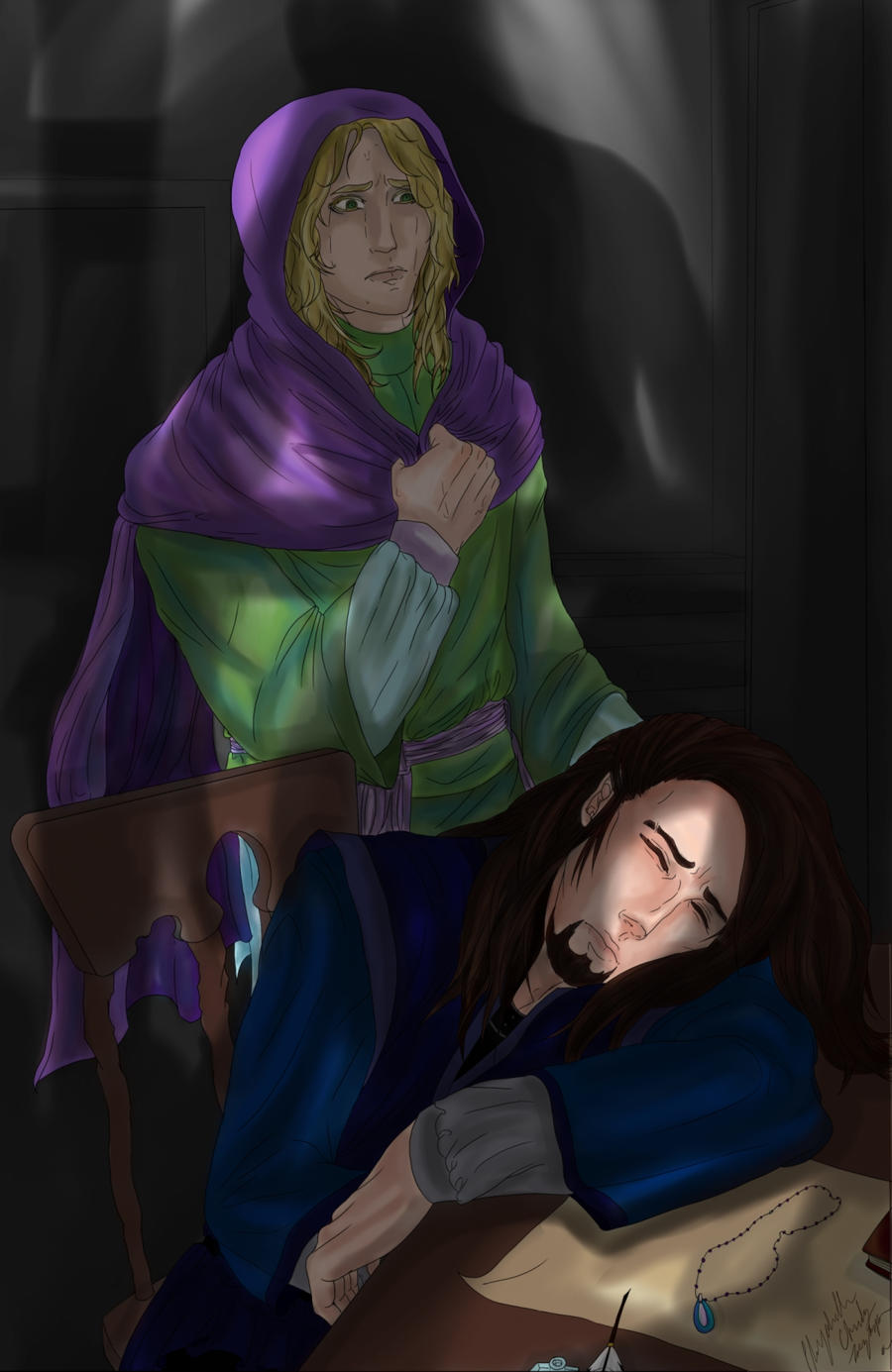
(c) Elizabeth Kelly - ToryKasper


Another example is one of my fantasy characters, Thei, the man in blue sleeping at the desk. This is a character who has hundreds of pages, over a dozen different forms since his creation, and who has grown, and changed and inspired me as a writer a number of times since I conceived him.

This isn't meant to be the most insightful of posts, but a look into my process, and how my characters grow. Sometimes I'm lucky enough to be able to visualize a character in my mind who doesn't need any outward attention to be easy to convey. Another of my collaborative works with Skoora is one of the few exceptions with my character Hal, who quite literally created himself and did and does whatever he wants. For a writer, this kind of character who can act on his own, remain consistent, but also grow, that is ideal. The sad truth is that this is often not true of many characters, and typically they need a nice nudge. Many writers do this through creating playlists, some watch movies, many (well most) read, and some of us draw.

So this brings me to my usual question. How do you find your inspiration, what ways really help you see your characters and inspire you to write? Do you have any suggestions to share?

Saturday, May 11, 2013

Weekly Vocab Word

su·sur·ra·tion (ss-rshn) also su·sur·rus (s-sûrs, -sr-)

n. A soft, whispering or rustling sound; a murmur.

[Middle English susurracioun, from Late Latin susurrti, susurrtin-, from Latin susurrtus, past participle of susurrre, to whisper, from susurrus,whisper, ultimately of imitative origin.]

su·surrant (s-sûrnt, -sr-), su·surrous (-sûrs, -sr-) adj.