Showing posts with label characterization. Show all posts

Monday, December 23, 2013

Do you Mary Sue?


I'm taking nine classes for the upcoming residency at Pine Manor College.  One of the classes focuses on speculative fiction, which, if you didn't know, is anything out of the normal realm.  It covers science-fiction, fantasy, horror, dystopian, and much, much more.  For this class, the professor assigned us all to take the Mary Sue Test prior to attending the residency.  It's actually a pretty cool little test.  I took it for my Death Man character and scored a 14.  I recommend everyone to take this test for at least one of their favorite original characters, and I doubly recommend this for those who dabble in the world of fan-fiction.

For people who don't know what Mary Sue means it is essentially inserting oneself into a story and creating a character that is impossibly perfect.  I think there is a masculine form of this term but just as Brony (a seemingly masculine term applied in general to those who enjoy My Little Pony: Friendship is Magic) covers everyone in the gender spectrum, so too does the term Mary Sue.  So take the test and see if your hero/in is too good to be true or too bland to be possible.  Post your scores if you like what you see or post them if you don't like then and give a comment on what you want to change for the character or if you feel that the score is unjustified for the specifics of your character.  Happy writing everyone and Happy Holidays, too!

This Deviant Artist hit the nail on the head in her depiction of a typical Mary Sue story.
Amanda LaFantasie © 2013

Wednesday, August 21, 2013

Language Creation

Language. What is it? A grouping of words, symbols, signs, gestures, and sounds used to communicate. Language is used everyday, from speaking to people, texting, computer programming, the posting of pictures, and so on. Suffice to say, language is important to know and understand the world around us.

But what about created worlds? What about the races and places that writers create? How do these people communicate? It is easy for an author to use their native tongue when their characters speak and think. I don't find anything wrong with that. It is easy - for some - to translate a few sentences into a different language. I do that constantly, changing English to Latin, French, Italian, and Russian. But I am a language nerd. I love various languages.

However, in my creation of worlds and races, I have backed myself into a wall of sorts. I have elves, vampires, sorcerers, witches, and so on. Each of these races have their own histories, and therefore, they need their own languages. But, how do I go about creating various languages for my races, without it sounding alien?

Tolkien is a great inspiration for language creation. Using the Elder Futhark Runes, he fashioned the Uruk Runes spoken by the Uruk-hai. The Cirth Runes - language of the Dwarves - is based upon the Anglo Saxon runic alphabet.

By following Tolkien's example, I am in the midst of creating a few languages for my various races. I am in the middle of creating a history for my vampire race. Finally figuring out where my vampires originated from, I can now use the languages from that area to create my own. For my vampires, I am mixing Elder Futhark Runes, the Lepontic (Lugano) language, and Ogham. I think that what I come up with will be fantastic, but it will take a lot of hard work.

http://www.omniglot.com/index.htm   This is fantastic website all about languages. Omniglot is the online encyclopedia of writing systems and languages. It has sections on phonetics, different writing systems, and sections about conlangs - constructed languages.

Here is to making the created world a little more complete, with a language of their own.


Sunday, May 19, 2013

A Writer's Journey - Art as an Inspiration

(c) Elizabeth Kelly (ToryKasper) & Amanda Lafantasie (Skoora)


Oh, it feels good to be back. I apologize for my recent absence. I was cleared by the admins to take a break away from DW in order to focus on my studies at Uni. Well now that the semester is over I make a triumphant return, and for my first post of the summer I want to talk a little bit about inspiration. This is something we as writers are all familiar with, and there are a million and one phrases (probably more) about where inspiration comes from, how we are our own inspiration, and how we use our inspiration.

Many writers (including myself) find inspiration from music. There are many other forms of inspiration though, and I thought it might be prudent to talk a little about my own writing process, and how I work through the pages. It's quite a simple issue, while being altogether complex. Let me explain this in one word. Illustration. In many ways I differ from most artists, who have an image in their head that they get down onto the page through words. My inspiration comes first from my artwork.


(c) To Elizabeth Kelly - ToryKasper

For example. This is a picture that I drew, that started one of the most in depth stories I've ever written, coauthored by Skoora (Amanda Lafantasie). this is only one example of how a picture has influenced one of my stories. I often will struggle with what to write, my imagination not as vividly connected to imagery as many of my fellow writers. So I put my thoughts down onto the paper in another way, and from a picture, even a simple one like this one, a story blooms. Sometimes the pictures are simple, sometimes they are more complex, but their purpose is always the same. In terms of a chemical reaction, an enzyme is used to speed up the process, to create a stronger reaction between chemicals, and this is what my artwork does for my stories. 

Typically, I have an idea, but then I struggle with how to represent that idea. How do I describe this character? How do I show this scene in words? In what way can I bring setting to life. When I cannot answer these questions easily, I'll turn to my sketchpad or my art program and I'll start to sketch. The characters with my greatest characterization are those I've drawn in scene. The picture above is my namesake character, Tory. He was first built off of a picture too horrible to share, but fundamental in his original concept. From that one picture over a thousand of pages of writing has been born; both collaboratively and on my own.  Through out the years since his conception (seven to be exact), he has evolved, changed, moved, and regressed a number of times. He has revealed to me a different part of him, and always through artwork. 


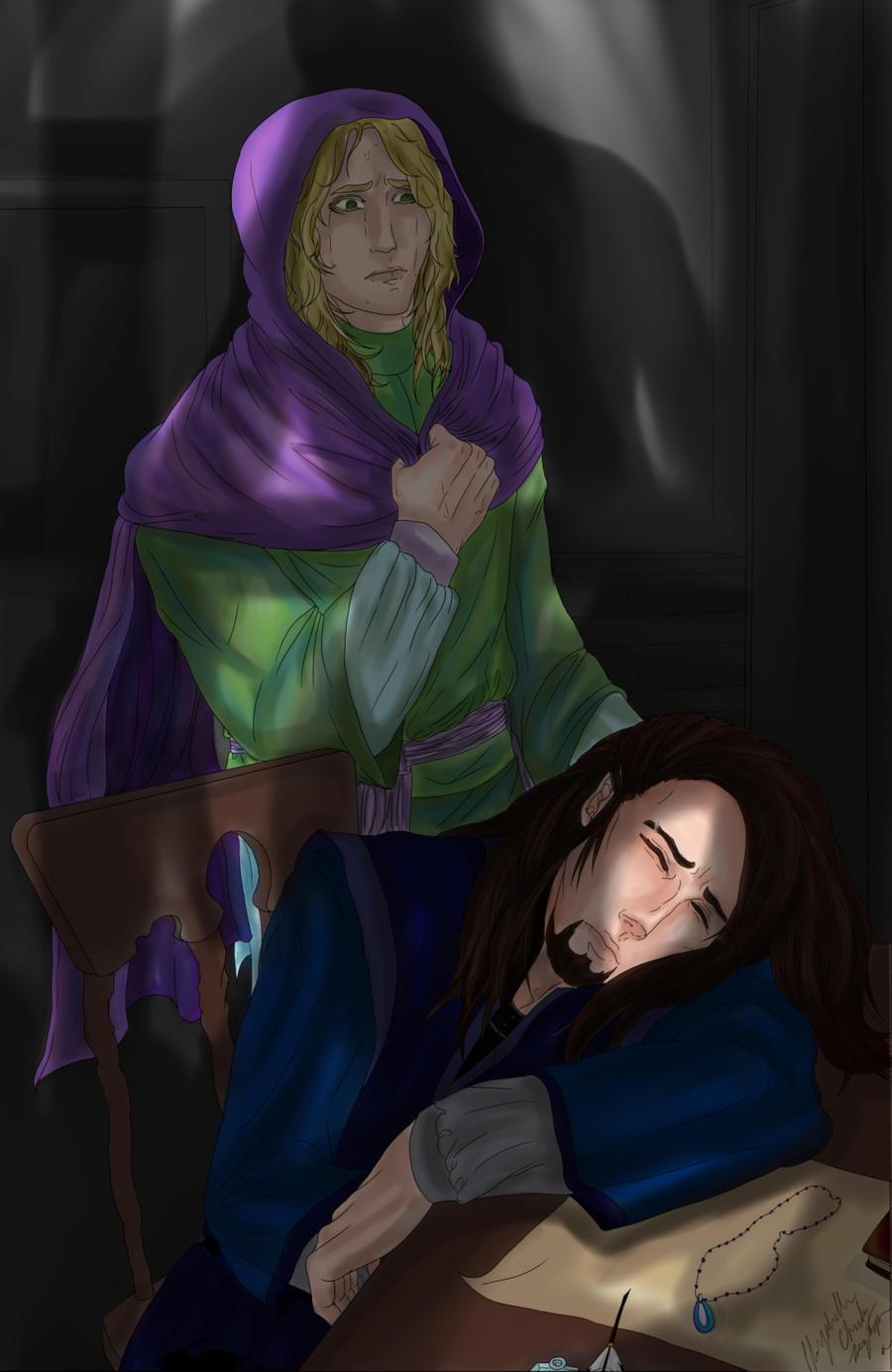
(c) Elizabeth Kelly - ToryKasper


Another example is one of my fantasy characters, Thei, the man in blue sleeping at the desk. This is a character who has hundreds of pages, over a dozen different forms since his creation, and who has grown, and changed and inspired me as a writer a number of times since I conceived him.

This isn't meant to be the most insightful of posts, but a look into my process, and how my characters grow. Sometimes I'm lucky enough to be able to visualize a character in my mind who doesn't need any outward attention to be easy to convey. Another of my collaborative works with Skoora is one of the few exceptions with my character Hal, who quite literally created himself and did and does whatever he wants. For a writer, this kind of character who can act on his own, remain consistent, but also grow, that is ideal. The sad truth is that this is often not true of many characters, and typically they need a nice nudge. Many writers do this through creating playlists, some watch movies, many (well most) read, and some of us draw.

So this brings me to my usual question. How do you find your inspiration, what ways really help you see your characters and inspire you to write? Do you have any suggestions to share?